
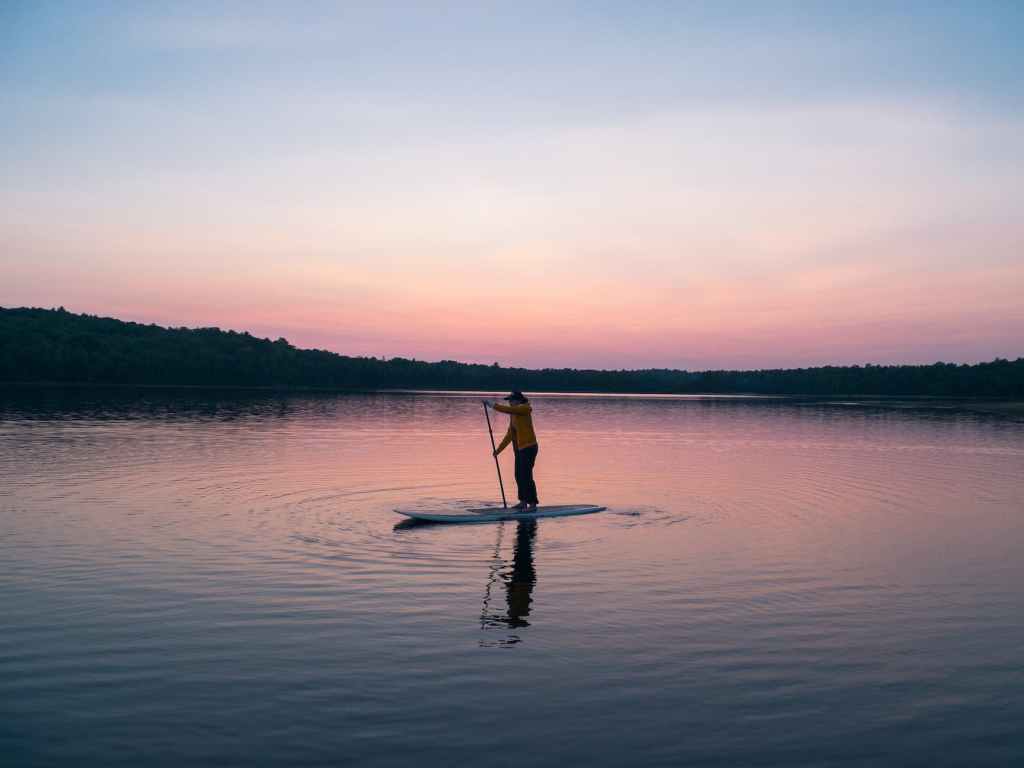
After watching excellent YouTube videos of Stand Up Paddle boarding (SUP) from the British channel SUPboarder, I decided to give paddle boarding a try. There were a couple of reasons for this. First, there is less equipment involved, which is nice. I get tired of lugging and washing all of my kayaking stuff. Second, an inflatable board rolls up into a large backpack, which is easy to store no matter where you live. A full-size kayak requires a large space with easy ingress/egress. My kayak has been living in my friend’s garage for the last 5 years because there is no room at my current residence. I was really hoping that I could just paddle board and live a simpler life. As you read this, keep in mind I only used my SUP for a year before reselling it. If you disagree with me, feel free to leave a comment.
SUP life
I have had superb paddles at the break of dawn on my SUP. It’s calm, quiet, and the birds are just starting their morning routine. It is liberating to stand up in the open, which is a much different experience than sitting in a kayak cockpit. It is a bit like walking on water, and the standing perspective can’t be beat. There is no question that paddle boarding is fun and taking over the paddlesports world.
My equipment consisted of a board, pump, paddle, leash, wetsuit, PFD, aqua shoes, water bottle, and marine radio. The board, pump, paddle, and leash came as a package from iRocker. I had the 11′ Sport model, which is one inch narrower than the standard model. Overall it was a nice package, with a triple action pump, carbon/glass paddle, and 3 layer PVC board. The wetsuit, PFD, and shoes I already had from kayaking, and the marine radio was insurance as I was a beginner paddling solo.
I quickly got used to standing up, even with the narrower board. Based on my experience with kayaking, I knew that I would eventually get used to having a little less stability, and the increase in speed seemed worth it. I have average balance and never done other board sports, like surfing or skateboarding.
When paddling with a double paddle, it’s a no-brainer to go straight; your strokes on either side balance each other out. With a paddle board, most beginners switch sides every few strokes to keep straight, but there is a technique to avoid switching sides until you want to. You incorporate a draw stroke to the beginning of your forward stroke. This pulls the nose out to compensate for the turning action of the forward stroke. I also learned to stack the hands, which means one hand is directly above the other in the forward stroke. This keeps the paddle vertical and close to the board, minimizing the turning moment of the stroke. My muscles ached at first, because the stroke relies on slightly different muscle groups than kayking. It was fun learning this new stroke, but also necessary. Sometimes the wind forces you to favor one side, so it is important that you can do so indefinitely.
Another key difference is the fixed fins on the stern of the board. They are meant to keep the board on a straight course. Without them, most folks would spin in circles. The fins form the pivot point for the board, which means the most effective turning strokes are done at the bow. I had fun doing cross-draws and cross-forward strokes. The draw stroke appears to play a much bigger role for SUP than in kayaking, which relies more on sweep strokes.
It’s not all roses
An inflatable board needs to be inflated. Some folks use an electric pump powered by a vehicle, others use a manual pump. My hand pump, which has two chambers, had three modes: both chambers acting both up and down strokes, both chambers on the down stroke only, and finally a single chamber on down stroke only. This allows you to inflate the board with a minimum of strokes. When the pressure is relatively low, you move the greatest volume of air. You know when to switch modes when it gets hard to pump. My best effort took 5 minutes to inflate the board to 15 psi. It was a workout, but I was nice and warmed up for paddling afterward.
PVC inflatables manufacturing uses nasty chemicals that are harmful to the environment. Typical lifespan of an inflatable board is 5 years; if you take care and patch leaks, perhaps you can double the life of the board. If I do get another board, it will not be an inflatable. I will acknowledge that a fiberglass kayak is not great in this regard, either. However, I am sure a kayak can last 50 years if you take care of it.
I could never hit 3 knots on my SUP, which is your average lazy speed in a kayak. The rear fins make significant drag, so one way to gain speed is to reduce the number of fins. My board had a 3-fin system, with a large main fin and two smaller side fins. Once you reduce the fin area, the board becomes harder to keep in a straight line. With the typical winds in the Bay Area, I never felt comfortable using less than three fins. After several months, I was able to replace the main fin with a smaller “river fin,” which bought me a little speed. Given my goal was to replace my kayak with the SUP, the lack of speed was disappointing. I was never expecting to be as fast, but my best effort could not keep pace with someone lollygagging in a kayak.
And then there is the ubiquitous Bay Area wind. The first time I tried my board was in a 15 knot head wind. I would mount the board, kneeling, paddle a few yards out, and stand. Once I got up, the best I could do was hold station, or go backwards. Even when I developed a stronger forward stroke, it took a long time to go anywhere in a 10 knot wind in the standing position. Your body simply presents too much frontal area for the wind to push back on. In a significant wind, kneeling or sitting is the only option. I took to waking up before dawn and checking the local weather station before heading out with my board. If it was blowing over 10 knots, I’d cancel. Since it blows more often than not in the Bay Area, I’d rather be in a kayak than kneeling on a board.
You might argue that a stronger paddler or a faster board could handle the conditions, but I have never seen it. In our typical conditions, I’d see kayakers, rowers, and outrigger canoes, but no SUPs. There is a kind of paddling called downwinding, where you paddle with the wind and waves, to a destination where you left a shuttle vehicle. That is logistically harder to do on one’s own, and I have gotten used to decades of out-and-back paddling in my kayak.
Conclusion
SUP is a lot of fun, and a great way to get on the water. I can see why people love it. I appreciate that it only takes a few pieces of gear to enjoy. For my needs, I found that a SUP could not keep up with my kayaking friends in the conditions we typically faced. That is not to say that I think it is an inferior sport; it just is better for different things. I can see myself getting another board some day, when my priorities are different.

 Misanthrope Hobbies