
The beginning
When I was in grade school in the 80s, a bunch of my classmates were boy scouts, and they all had Swiss Army Knives (SAKs). In 1985, the show McGuyver gained popularity, and you just had to have an SAK after watching the main character solve every quandary with his trusty knife. Then there was Mr. B, my electronics teacher in high school. Every day in class, he’d whip out his SAK and clean his fingernails with the main blade. My sister gave me my first Victorinox; ever since then I have always had one. I wasn’t really an outdoorsman, nor was I into knives. An SAK just seemed useful. Back then, the only tools I knew how to use were the screwdrivers and the blades.
Knife enthusiasm
12 years ago, I joined Bladeforums and learned more about knives than I could ever imagine. The SAK became passé. By modern standards, it could not be opened with one hand, lacked a pocket clip, didn’t have a lock, and was made of cheap stainless steel. The standard of a knife was set by edge retention and destruction testing meted out by Youtube influencers.
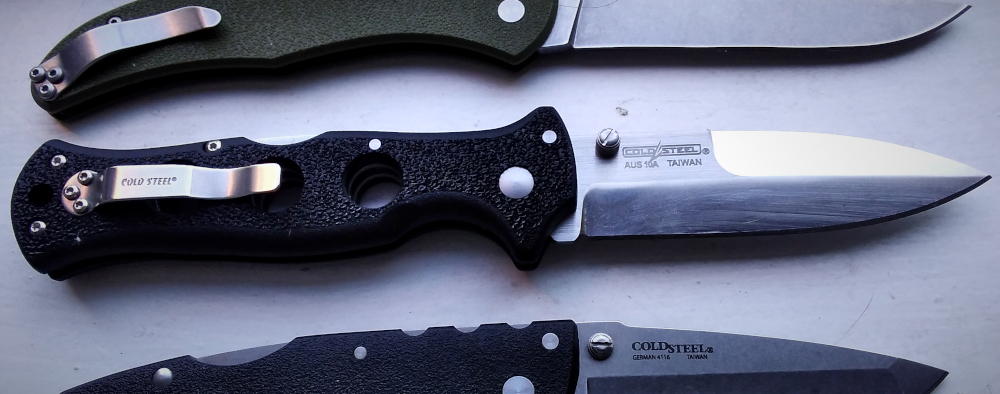
My interests fell into three categories: bushcraft, tacti-cool, and international traditionals. Bushcraft is a set of skills that draws from primitive technology, survival, and wilderness living. A typical bushcraft knife is a fixed blade with a length that spans the palm of your hand, and should withstand the use of a baton. Tacti-cool are knives that titillate one’s inner secret agent, military operator, mall-ninja, or what have you. It is the knife that you finish the boss baddie with at the end of an action flick. For me, Cold Steel was the brand that embodied the warrior ethos, and their knives make up the bulk of my collection. International traditional knives are designs that have existed for decades, if not centuries. They are usually very functional, with handsome wooden handles, and are very inexpensive. I had a fun decade trying out these knives, improving my knife sharpening, modification, and usage skills.
Back to Basics
This year, I have gone back to carrying an SAK in my pocket. Felix Immler’s YouTube channel played a big part in that. Apart from his irrepressible enthusiasm, Felix creatively showcases the versatility of the SAK. The three pillars of his channel are 1) how-to videos for each tool, 2) projects using the SAK, 3) modifications. My favorites are sewing an anorak with the reamer and crafting snow shoes. If you have not seen his channel, I strongly recommend it. Notice how Felix is doing “real” work with his SAKs, and they are not falling apart.
The SAK serves my use case perfectly. I only have a few cutting and tool needs each day; if I needed to use my knife professionally, I would choose a tool designed for that job (probably a utility knife with replaceable blades). An SAK is on hand at all times, and can usually serve in a pinch when one is too lazy to walk over to the toolbox. Opening with two hands is a minor hassle due that does not faze me, and the lack of a lock is not dangerous as long as I use the knife accordingly.
What I love about the SAK:
- Value. Quality to price ratio is off the charts. Victorinox has invested in automation to control costs, and have managed to keep prices low while maintaining the highest standard in mass-produced knives. I have never gotten a lemon from them. Knives are always razor sharp, springs are snappy, tolerances are tight, and each tool has a nice mirror polish. I would easily pay twice the money for an SAK, but I don’t have to.
- Form follows function. The SAK is designed to be used as a tool first and foremost. There are no cosmetic gimmicks; each feature exists because it serves a purpose. The handle is a simple shape that is comfortable to hold. All the tools fit flush so nothing bites into your hand. All the tools do their job well.
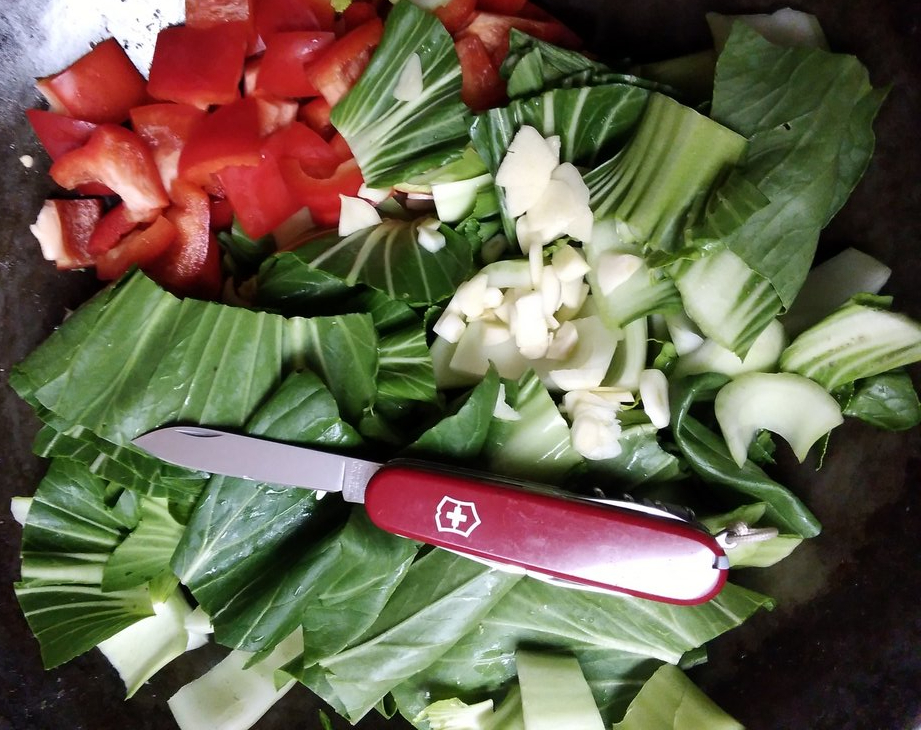
- Blade geometry. The SAK blades feature a flat grind. This is not the strongest grind, but it slices and dices with the best of them. Got some apples, salami or cheese to cut? SAK’s got you covered. It can even prepare dinner!
- Ease of maintenance. The stainless steel on SAKs is basic, with relatively low hardness and edge retention. To me, that is a good thing. Even though the blade dulls quickly compared to modern super-steels, it has plenty of edge retention for everyday tasks, and is very easy to sharpen using the most basic tools. If you are new to sharpening knives, an SAK is a great blade to start with. Also, this steel is very rust and corrosion resistant.
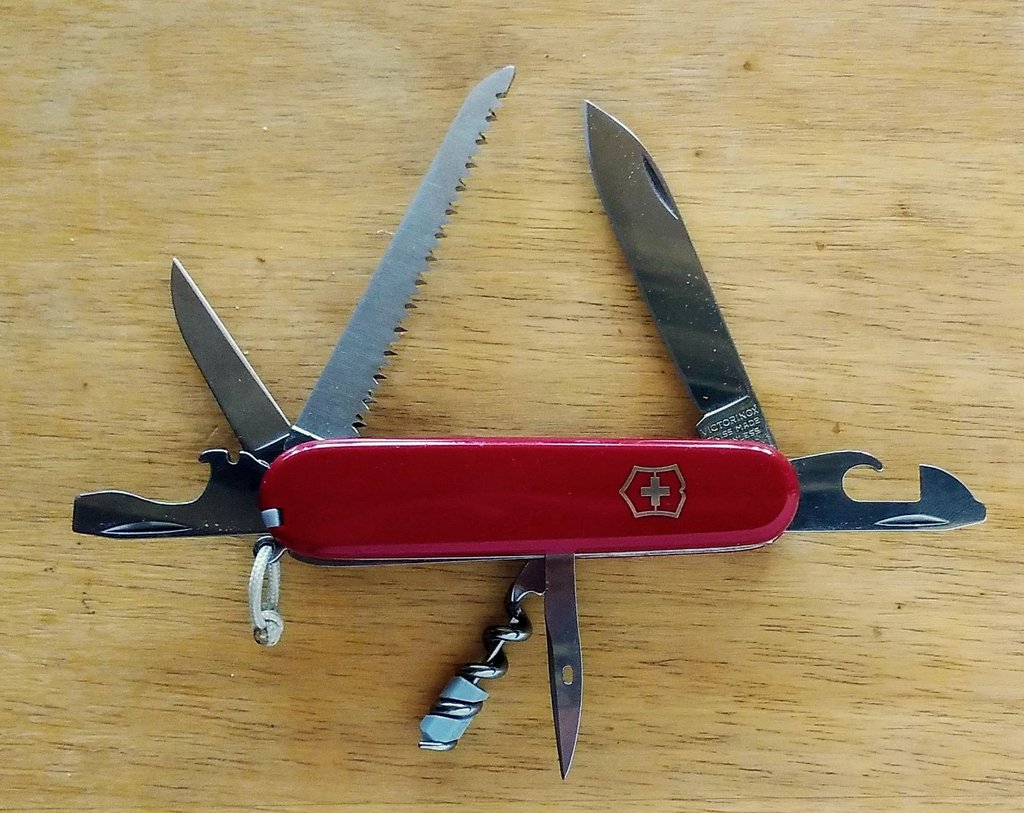
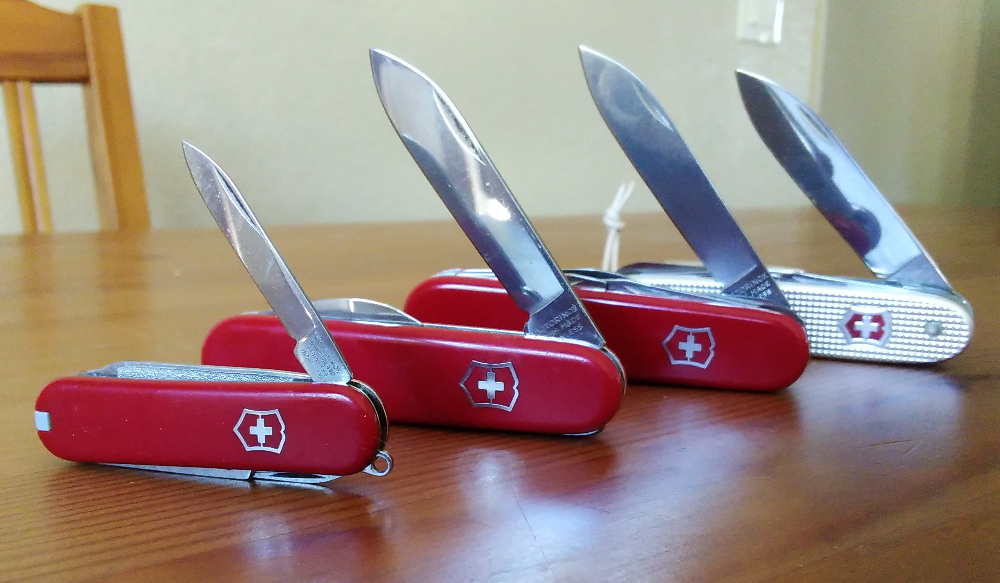
- Variety. There are so many models to choose from, with 5 different sizes among them. The larger ones feature locking and one-hand opening blades, while the smallest serve as key fobs. With a plethora of tool combinations, you should be able to find something up your alley. Currently, I carry the 54 mm Classic SD (screwdriver) on my keys, along with the 91 mm Camper, which has a large blade, small blade, saw, can opener, flat head SD/cap lifter, corkscrew, reamer, toothpick, pin, and tweezers.
- Easy to carry. Most SAKs are compact and light enough to drop into your pocket. I find this to be true with anything 3 layers and under. My Camper weighs 2.5 ounces, which is amazing considering all its capabilities. Pocket clips have never been my thing; the knife gets in the way when I reach inside my pocket, and clips broadcast “everyone, I’m carrying a knife.” When I do take out an SAK, people see it as a tool, not a weapon.
What about Multi-tools?
By multi-tools, I’m referring to the folding pliers (and other tools) popularized by Leatherman. Some folks swear by them, and I can understand that. They have never appealed much to me, because I don’t need pliers that often. Multi-tools are boxy, heavy, expensive, and require a belt sheath. If I ever carried one, I would still have an SAK in my pocket, because an SAK is first and foremost, a knife.
Conclusion
I just moved a month ago, becoming a full-fledged homeowner. That chaotic process cemented the SAK’s value in my mind. When other tools could not be found, the SAK was indispensable. Here is how I used each tool:
- Blades: the small blade gets used the most for opening packages and bags. The big blade cut lots of rope during packing.
- Flat head SD/cap lifter: other than opening drinks and turning screws, I sharpened a corner at the tip enough to cut packing tape. This saved my blades from getting gunked up by adhesive. I also opened a bunch of paint cans; it handled the prying fine.
- Can opener/small SD: I opened a can with it, because my real can opener was in a box somewhere. I also turned lots of Phillips screws with this (yes, it is designed for this). I was also able to pull small nails by hooking the head with this tool. No pliers, no problem.
- Saw: I cut pieces of wood to block windows from opening too far to deter break-ins. I also cut notches in a piece of plywood to make it fit between studs.
- Reamer/awl: to organize the shed, I made holes in the handle of tools so I could hang them up.
My SAK did all these jobs and is like new, without a hint of looseness. What more can I ask for? If I had to give up all my knives and keep only one, it would be an SAK. The more utilitarian something is, the more I like it. A Swiss Army Knife is about my most favorite thing.

 Misanthrope Hobbies