
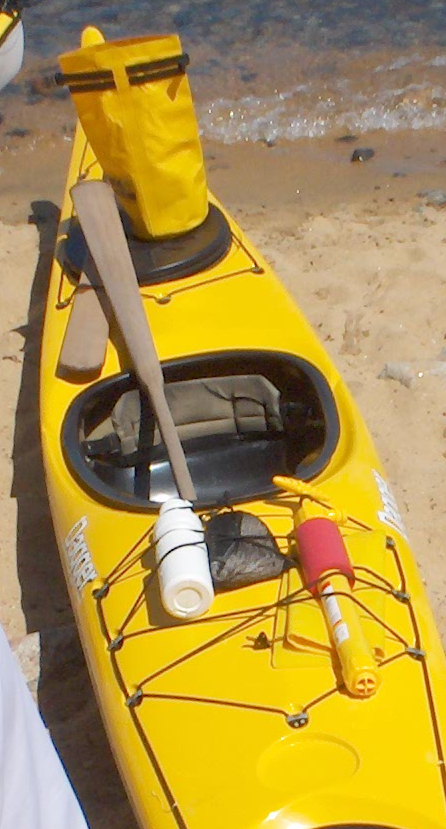
I own a few extra knick knacks, but this is the gear I bring every time on the water.
Kayak
I’ve paddled a Dagger Meridian for 25 years. I purchased it after 2 years of rentals and trying out various designs. Had I purchased a boat at the start of my paddling career, I would have outgrown it. The Meridian is a closed-deck kayak intended for intermediate paddlers. Its hull is based on Greenland style kayaks, but has significantly more volume in the center to accommodate larger paddlers and provide more stability. Mine is one of the early fiberglass models that has no skeg. At 16 feet long, it was considered short at the time of purchase, but boats seem to be getting shorter over the years. Its beam is 22 inches, which seems narrow to a beginner, but it has plenty of stability. I am average height and I have weighed 160-190 lbs.
My kayak is fast and I have no problem keeping up with a group. It also likes to surf, which is a lot of fun in following seas. It is easy to roll, with a low enough rear deck to perform lay back rolls. There are fore and aft bulkheads, which limit the water it takes on after a wet exit. There is enough room to pack for a week-long trip (if you pack like a backpacker). Overall, it is a boat that is responsive to paddle strokes and body action.
The Meridian is not without its down sides, though. Tracking in a straight line is not its strength. Because it is so responsive, the boat tends to zigzag. It also wants to turn into the wind, so you need to be assertive with your corrections to stay on course. See the section on edged turns in my post on advanced kayaking skills if you need clarification. The hatch covers leak because they are attached with rivets, instead of glass tape and epoxy. It uses a plastic extrusion for the deck/hull seam, instead of more expensive taped seams. But, it has gone 25 years, and has plenty of life left in it.
My advice is to rent a bunch of different kayaks and participate in demo days from local vendors. See what suits your style, or develop a style first before shopping for a boat. If I had to do it over again, I would absolutely buy the same boat.
Paddle
For the first 9 years, I paddled with a European-style paddle. It was a nice Werner fiberglass paddle that was durable and powerful. Then I saw someone perform rolls with a Greenland paddle. It looked like magic, and I had to have one. I purchased an 8′ cedar 2 x 4 and followed Chuck Holst’s plans from QajaqUSA. I made the paddle with a hand saw, plane, and spokeshave. It’s been 18 years and I am still using the same paddle. There was a brief learning curve, but it was an easy transition. I could still easily keep up with my friends. Making and using your own paddle is a special feeling, second only to making your own kayak. I never did learn new rolls, but the Greenland paddle is fun to use nonetheless. It lends itself to extended paddle strokes and changing of hand positions to add some variety to one’s repertoire.
I also carry a shorter “storm paddle” as a spare. It requires a special sliding stroke to use, which is fun to practice. You can purchase a two piece paddle to slide under deck bungees. I’ve never lost or broken a paddle, but the possibility is always there, especially if you paddle with others. It only takes a moment of inattention to lose a paddle.
PFD (life jacket)
Make sure you get one that is designed for paddling, so it does not restrict your arm and torso movements. I have had cheap ones, and I have had nice ones. The more expensive ones use tougher fabric, so they will last longer. If you think “I can swim, I don’t need a life jacket,” then you are missing the point. If you wet exit, you will need to hang on to your paddle and boat, then execute a self rescue in freezing cold water. Having to swim on top of all that complicates matters unnecessarily, especially when you can’t afford to screw up.
Spray skirt
A spray skirt contributes greatly to the sea-worthiness of a kayak, allowing you to take on rough water and breaking waves. The main purpose is to keep waves from flooding your cockpit. An inexpensive nylon skirt will do. One with a neoprene waist will take on less water when you are upside-down, but hopefully you won’t be in that position very often. Remember to always place the pull loop on the outside, so you can release the skirt during a wet exit. A spray skirt keeps you warm as well, which is one of the big advantages of a closed-deck boat.
Wet suit
The average water temperature of San Francisco Bay is 54° F. It’s much lower than your body temperature, and water is a good conductor of heat. You have precious little time before hypothermia robs you of strength and coordination. Getting suddenly dunked in cold water also causes a shock that makes you gasp. Wearing a wet suit can help mitigate these effects. My kayak shop carries 3 mm neoprene farmer john suits, which is what I use. If I am paddling in open water, I always have a wet suit on, even in the summer (the bay only warms slightly). Kayaking is a water sport, and you should dress for immersion. It’s silly not to.
Paddle jacket
If you paddle year round, you will want a paddle jacket to ward off the biting cold winds of winter. Foggy summer days in San Francisco can be quite chilly, too. Again, a simple nylon jacket will do, but make sure to get one designed for paddling. A regular jacket will probably not hold up as long nor keep you as dry. It tends to be colder out on the water, so don’t be fooled by how warm it feels on land. Unlike other forms of boating, you will get wet kayaking. Being cold and wet quickly spoils any paddle excursion.
Water shoes
You can wear old sneakers, sandals, or cheapo water shoes from the sporting goods store. Don’t go barefoot or in flip flops. If you wet exit near rocks, barnacles, or an old pier, the chances of cutting up your feet are pretty good. You might also have to carry the kayak a distance from your vehicle to the launch spot, so it’s good to have decent shoes. Most places have broken glass, nails, screws, or medical waste strewn about. I have a pair of NRS neoprene shoes that are quite durable and worth the money.
Pump and Paddle Float
A hand operated bilge pump and inflatable (or foam) float are necessary for rescuing yourself and others. Most beginner kayak lessons will teach you how to use this gear. I believe paddlers should be responsible for their own safety out on the water. Think of them as a very inexpensive insurance policy. A good pump and float should last about 10 years.
Roof rack, saddles, and straps
I have used the same Yakima rack for 27 years. I’ve had to purchase new mounting clips when I switched cars. I use foam saddles, which are adequate for the job if you can keep them from sliding side-to-side. I take the racks off when I am not hauling my boat, because their aerodynamic drag will rob you of up to 3 mpg. Use straps that are meant to hold kayaks and learn to use them properly. Attach a bow line for backup in case your straps fail. You don’t want to be the cause of a horrific accident.
Other stuff
Dry bag – a small dry bag is good for holding your wallet, phone, keys, and food. Keep it tethered to your boat. You might consider double-bagging your phone.
Tow rope – mine is just 25′ of 1/4″ nylon cord attached to a loop large enough to sling around my shoulder or waist. The loop is tied with a slipped sheet bend that acts as a quick release. It is probably not the best setup, but it has worked every time I’ve used it. You can purchase a towing belt if you wish.
Hat/sunglasses – The sun can be twice as intense on the water, because it reflects off the surface. I have had sunburn on the bottom of my lip before.
Knife – Once, we encountered a seagull entangled by fishing line, and none of us had a knife. You can spend lots of money on an expensive salt water knife, or just use a cheap stainless steel knife and wash it with fresh water after use.
Whistle – Buy one and attach it to your life jacket. You might need to get the attention of someone in your group, or warn a boat that is on a collision course. It’s much better than shouting.
Water bottle – get one that has grooves, so it stays secure under bungee cords. Staying hydrated is important because paddling can be hard work.
Sponge – you almost always get a cup or two of water inside your cockpit. A sponge is good for removing that quantity of water.
Plastic bin – I have a large Rubbermaid bin for transporting all my wet gear. I can’t imagine kayaking without it.
Eyeglass retainers – this is a must if you wear corrective eyeglasses.
Dry change of clothes – the day you forget to bring it will be the day your bum gets soaked.
Conclusion
If this sounds like a lot of stuff… it is. Boating is an expensive hobby, but kayaking lets you enjoy the water for a fraction of operating a motor or sail boat. In 1996, I invested around $4,000 on new gear. I probably could have saved at least $1000 if I had purchased used gear. After the initial investment, I’ve only had to replace worn out garments, but not the expensive stuff. I’ve taken hundreds of trips in my kayak; the memories, adventure and exercise are well worth it.
 Misanthrope Hobbies