
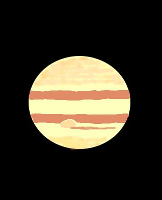
The opposition of Jupiter in 2023 took place on Nov. 3. On this the day the gas giant was closest to earth for the next 13 months, giving us the best viewing through a telescope. In practice, any night within a month of opposition can give great views of a planet. From 0000-0030 on Halloween, October 31, it was a clear, cold night in my neighborhood. Taking advantage of the opportunity, I set up my trusty 100mm, f/9 refractor.
View at 28x with 32mm Plossl eyepiece
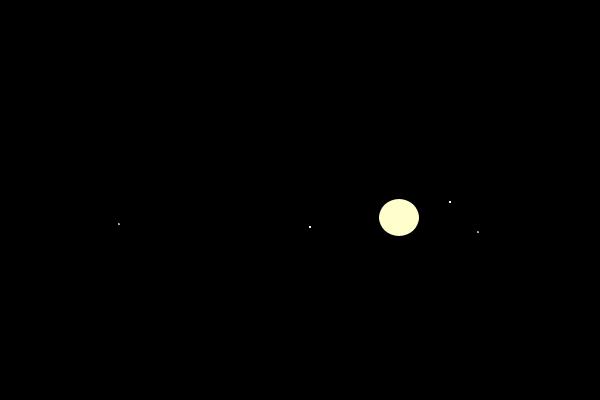
Jupiter is my favorite object to observe in the night sky. It is bright enough to see in urban light pollution, its moons are constantly dancing around the planet, its equatorial bands vary from year to year, and the great red spot can wow you. Jupiter should be seen at different magnifications to appreciate all these characteristics. I started with a wide view at 28x, using my 32mm plossl eyepiece. Jupiter is very bright at this magnification, making it difficult to see any details on its disk. All four moons were visible, with two of them appearing brighter than the others. If one moon is not visible, it could be behind the planet, or in front of the planet (if you’re lucky). A moon crossing in front of the planet is called a transit, and the dark shadow of the moon can be seen crossing the planet’s surface. I was not going to see a shadow transit on this day, but it is possible to plan for one using tools like Sky and Telescope’s online app. To use this app, make sure you convert your local time to Universal Time. Planning ahead is worth the effort, because a shadow transit is a proper treat. By observing Jupiter’s moons, Galileo deduced that the moons were revolving around their planet, clashing with the geocentric view of the universe in his time. Jupiter’s moons can also be observed using binoculars if you hold them steady, although only the brightest moons may be visible.
View at 60x with 15mm Plossl eyepiece
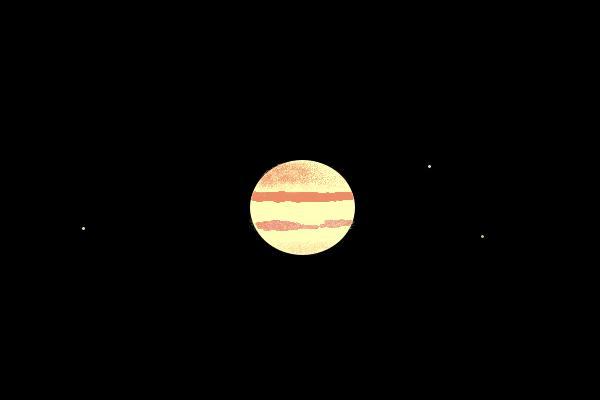
The northern and southern equatorial bands are visible, with good color saturation. There is darkening in the northern polar region. The southern equatorial band appeared lighter, and it looked somewhat interrupted. At this medium magnification, I could tell the seeing was not great. The image would blur and momentarily sharpen due to atmospheric air movement, or mirage coming off of nearby buildings. So, this wasn’t going to be an epic Jupiter viewing day, but, a few moments of clarity are much better than none.
View at 120x
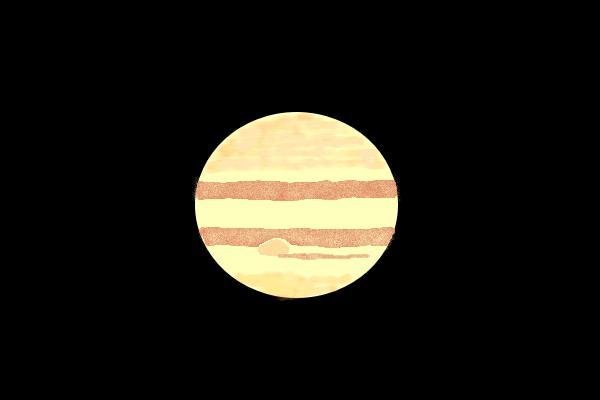
At high magnification, I could see a major disruption in the southern equatorial band, and only the great red spot (GRS) could create such a sight. How lucky! I waited for moments of steady seeing to be sure it was the GRS. Using Sky and Telescope’s GRS transit calculator, I was able to confirm my observation afterward. The GRS had a light rust color to it, with a visible gap between it and the southern equatorial band. Even more remarkable, it was trailing its own dark band behind it! This is new for this year and is why Jupiter is always worth revisiting. Jupiter’s dynamic atmosphere and powerful storms always keep observing interesting. Given the unstable seeing, I decided not to push magnification further. I really enjoyed my time with Jupiter; it is a showcase object for any size telescope.
The moon
The moon was right next to Jupiter on this night. Since it is also a good high-power object, I swung the scope over for a look. It was in its waxing gibbous phase, on its way to becoming full. When observing the moon, the most detail can be observed along the terminator, the edge between shadow and light on the surface of the moon. It is sunrise at the terminator, so long shadows render the most detail in craters, mountains, rilles, and other lunar features. I was already cold, and had not planned ahead of time for this day of the lunar cycle, so it would be a quick look.
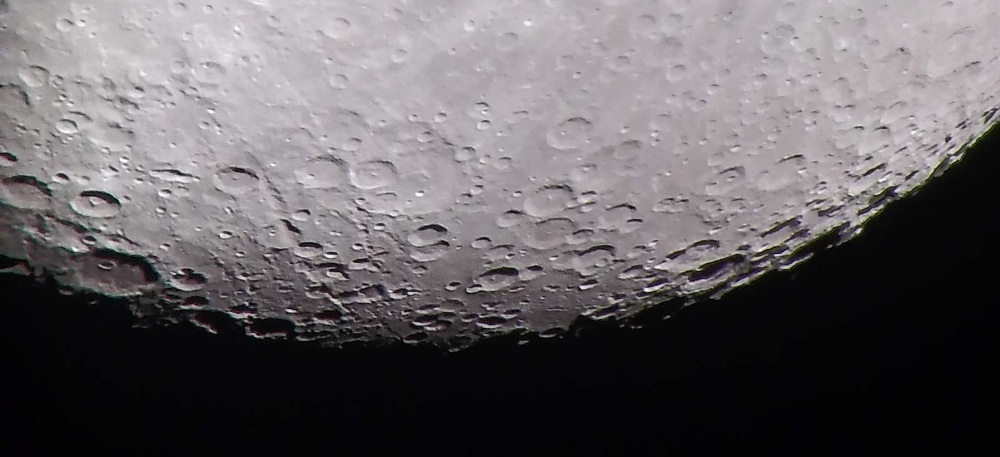
This was a snapshot of the terminator, made by holding my phone to the eyepiece, to give you a sense of what I saw. At the eyepiece, the view is much sharper with greater contrast. As the moon moves through the field of view, it really feels like you are flying by in a spaceship. Lunar observing is a discipline in itself, and there are many websites, forum posts, and books dedicated to the subject. The geological history of the moon is fascinating; learning about it adds a lot of context to what you are seeing. Here is a decent intro site on lunar observing (accessories are not required to observe the moon), and a more scholarly site with further references to get you started.
Thanks for reading! Jupiter and the moon are also good viewing in binoculars. If you have some, go out and take a look!
 Misanthrope Hobbies