

Let me start by saying that this is a good problem to have. There are people who don’t know when their next meal will be, or where they will sleep tonight. If I sound whiny in the rest of the article, that’s on me, and I will try to be better. I am 52, don’t have children, so your perspective might vary.
You can’t have it all
The most common example of this concept is Pick any two: Cheap-Fast-Quality, or some variation thereof. You can get any two, but at their intersection lies a compromise on the third.
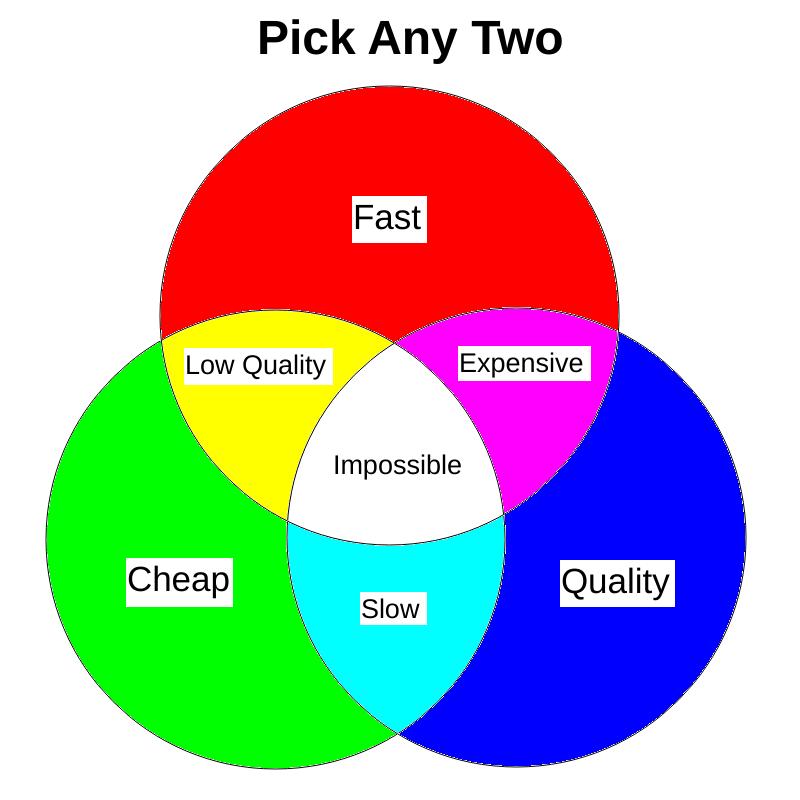
Once in a while, you might get lucky, but it’s impossible to consistently get all three. For example, you can get a cheap fast food meal, but the nutritional value and ingredients will be lacking. Or, you can send a package for less money in 5-7 days, but expediting will cost handsomely.
This illustrates that compromise is a part of life. Pursuing the impossible is most likely counterproductive. This is a useful model to apply to other topics, by coming up with another trio of desired qualities.
Time vs. Money
For a long time I knew that life was a trade-off between time and money. Time is the freedom to do what you want, when you want. Money is having the resources to live and afford the activities you enjoy. Only lottery winners and silver spoon recipients can have both. You can have a lucrative job and afford nice toys, like a yacht. But how often do you get to sail that baby? Most boats collect barnacles in a marina slip, which also costs money. Two weeks of vacation are gone in no time. When you earn extra vacation days, they come with extra responsibilities, so it is harder to get time off.
I’ve enjoyed ample free time during unemployment, but it’s disquieting to watch your bank balance dwindle at a steady pace, like snow melting on a spring day. When I was young, I had plenty of time, but a poor idea of how to spend it. “Youth is wasted on the young,” said George Bernard Shaw.
The third ingredient
What goes along with time and money? Happiness? Fulfillment? I struggled to find this third idea, because the first two are so forceful in modern life. I finally chose health, so the diagram looks like this:
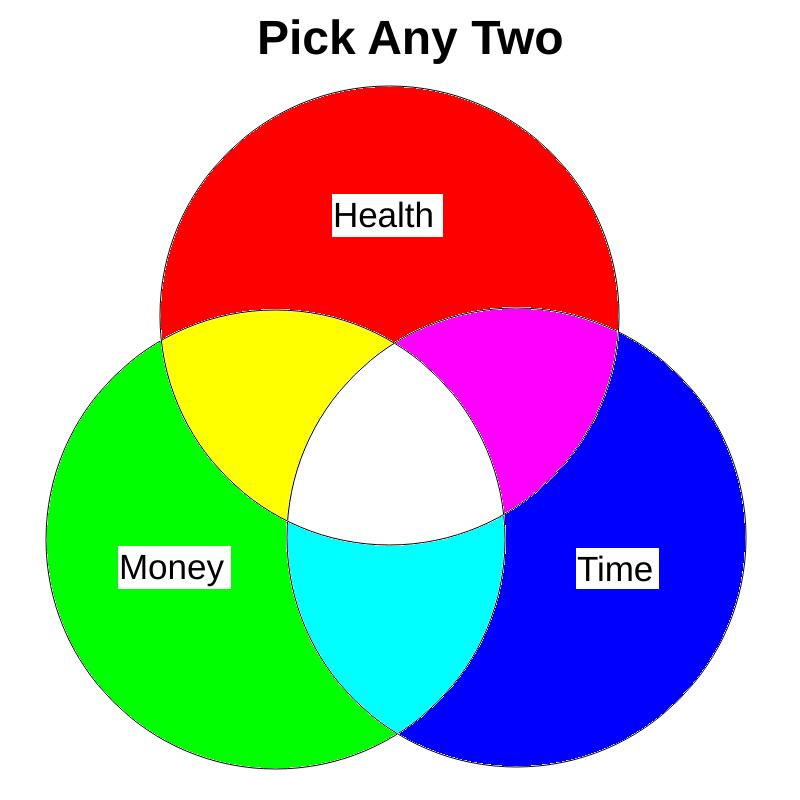
I’m still young enough to take health for granted, which is why it was hard to see. Health has physical and mental components to it, so things like happiness, gratification, love and physical well-being all contribute. I’ve had a few health issues, enough to know that I can’t enjoy money or time when I am sick.
Fleshing out the model
What goes in the intersections? What connects money and health, time and money, health and time? To me, Mr. Shaw’s quote provides the clue. It is the dimension of time, i.e., time in one’s life.
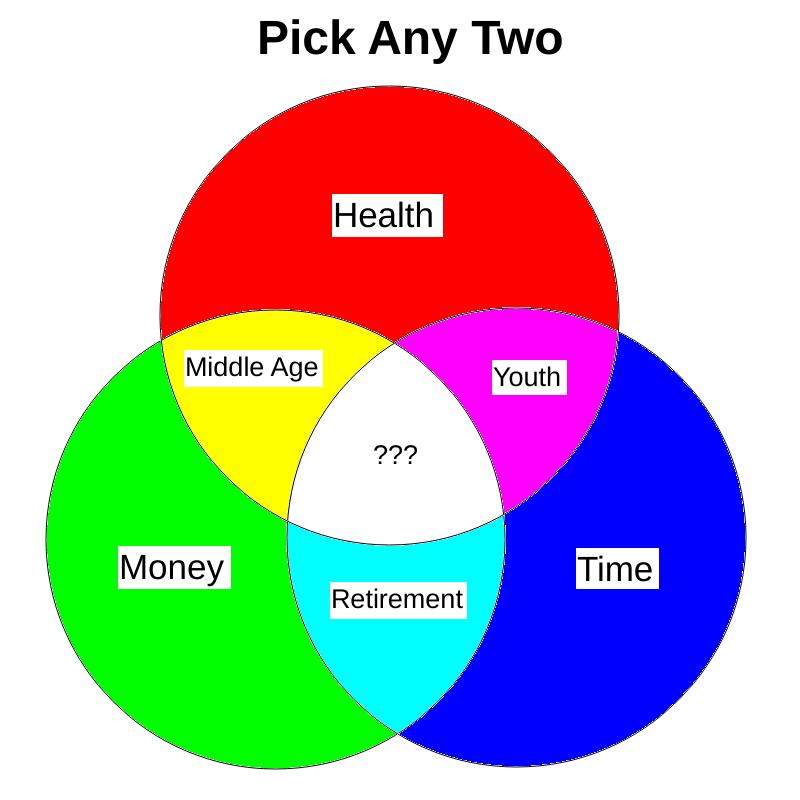
In youth, we feel invincible, have our lives in front of us, but no money, at least for most of us. In middle age, we expend our physical, mental energy and time on earning money, being responsible, pursuing success (whatever that means). In retirement, hopefully there is free time and money, but the health window to enjoy them is papably diminishing.
Beating the system
Now that we understand how things work, is there a way to win, or refuse to play? Societal norms prioritize money above all else, so rebels are naturally drawn to health and time. FIRE (Financially Independent, Retire Early) is one example of this. The idea is to save up so much money that you can stop working in your 30s or 40s by living off your investments and side hustles. This way of life requires intense financial discipline, so FIRE is very difficult in our consumerist society. I wasn’t smart enough to invent FIRE in my youth, and the opportunity has passed me by.
The tiny house/van life/digital nomad movement is another way people are choosing to redefine the terms by which they live. For reduced living space, material wealth and comfort, one is rewarded with freedom, adventure, and new friendships. This lifestyle has immense appeal to me, but as a married man, I know it will never work with my wife. With advancing age, the availability of a bathroom on demand takes on exponential importance. Plus, I’m not sure I am clever enough to earn a living while enjoying life on the road. One thing I’ve noticed is that many of these practitioners depend on the generosity of others, such as living on someone else’s property. To me, that is not true freedom.
Conclusion
I suppose I will be figuring this out until the very end. Here is how I am living my life now.
- Don’t take anything for granted – “This, too, shall pass” applies to good things as well as bad. Be grateful for all good things and savor them, because change always comes. I believe that gratitude is one of the pillars of happiness.
- Don’t waste time – a corollary of the previous point is that time is limited, so I should be working towards my goals now. Wasting time is a luxury I have indulged in too often.
- Assess the situation – It’s easy to get complacent. I have spent most of my adult life counting the days at a job that turns into years. Like most people, I learn by experiencing what not to do. Stepping outside of the daily grind to assess what is working, and what is not, is something I have to force myself to do. Part of it is also being true to oneself, which is not easy.
- Defining my success – I think I have finally let go of the expectations other people put on me. What to value and prioritize is up to me, so failure is also mine to own. I am less afraid to fail than ever. In fact, failing is a good thing, because it means I am trying.
I have never put much stock in wealth or titles. That said, it’s nice to have shelter, regular meals, healthcare, and other basic needs met. My goal now is to sustain myself doing things I like. As long as I progress towards this goal, I am happy.
 Misanthrope Hobbies