I have wanted to play music for a long time. The ability to play an instrument seems like a super power. Music has the ability to affect a person in a way that is impossible to verbalize. That said, I am a lazy musician, and no one has ever asked me for an encore. Even if it is just for myself, making music is physiologically and psychologically enriching.
As a boy, I learned violin for several months, until I got tired of practicing. As an adult, I have tried playing the harmonica, recorder, ocarina, ukelele, among other things, but something just clicked when I saw someone pluck a string and create notes with a slide.
The Diddley Bow
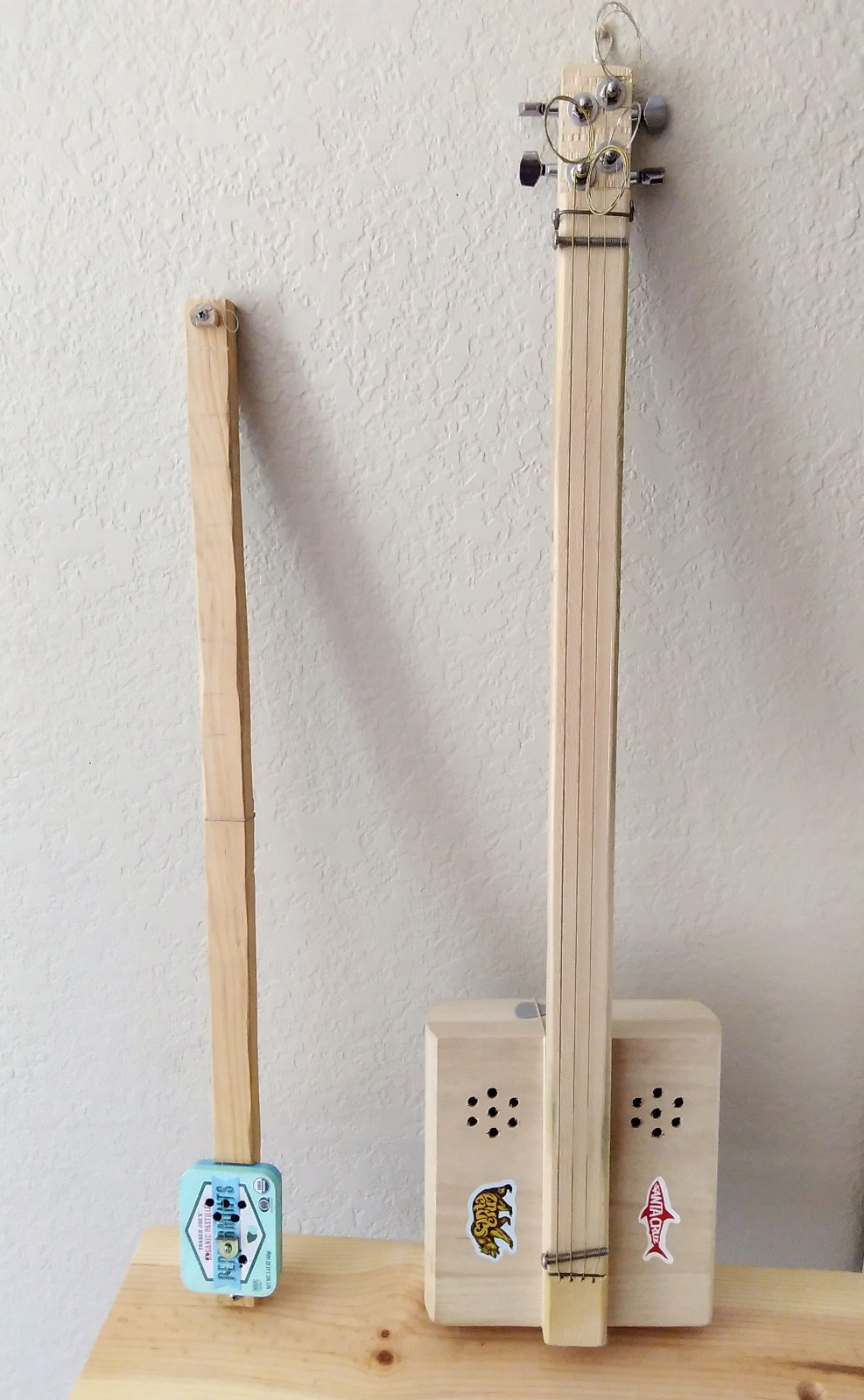
The diddley bow is a one-string guitar, consisting of a string or wire, a piece of wood, and a resonator (like a glass bottle). It is usually played with a plectrum (pick), but fingers can also be used. Similar instruments exist all over the world. Notes are made with a slide made of metal, glass, or other rigid material. The further down you slide, the higher the note. A real guitar has six strings, so is it possible to play music with just one? It is if you are an artist, like One String Sam:
A driving rhythm, an expressive voice, and a story to tell are all you need. I was drawn to this kind of blues when I heard it, and it drove me to make my own diddley bow. The first thing I learned to play was the “Smoke on the Water” riff. If you don’t know what it is, allow my friends to remind you:
There are many instructional videos on how to make and play a diddley bow, but my biggest influence has to be Justin Johnson. His guitar hero style is catchy, but he also pays homage to the roots of this music. Have fun finding the style of music you like to play.
One String Sam’s “My Baby Ooo” and the “Smoke on the Water” riff are played on the pentatonic scale. You will also hear it in Lil Nas X’s “Old Town Road.” Many blues songs use the pentatonic scale, as well as Native American and other types of indigenous music. The pentatonic scale sounds like this:
To start, I practiced this scale until I was able to do it forwards and backwards while accurately hitting each note (more or less). Once I developed the muscle memory, it was a lot easier to play a song. The diddley bow I am playing consists of a fishing line stretched over a mint tin. I am using a copper pipe fitting for my slide.
Some folks mark notes on their neck, to place the slide visually. I did begin this way, but I gradually learned to use my ears to slide up to the note without looking. If you watch carefully, you will see me doing this as I play up and down the scale.
Here is an excerpt of “I wish I was in Heaven Sitting Down,” played on one string using the pentatonic scale:
The Diddley bow teaches about the use of rhythm, and the articulation of notes. Limited to one string, good players can make the instrument speak. Because it is possible to make any note, you can play any genre of music. You are only limited by your creativity. Here is “When the Saints Go Marching In” with a little bit of improvisation. You should have fun with music.
Multiple Strings
When folks are ready to graduate from the diddley bow, they usually make or acquire a 3 string cigar box guitar. This opens up a bunch more options, such as,
- Do you use a fretted neck and learn chords?
- Do you use a pick or play fingerstyle?
- How do you tune the strings?
A lot of this depends on the genre of music you want to play. In addition to Justin Johnson, I learned a great deal from the Shane Speal and Puckett Cigar Box Guitar YouTube channels. For me, I didn’t want to bother with fretted necks, didn’t care to learn chords, and didn’t want to read music. I just play by ear and try to pick out the tunes that I like.
My first 3-string was made with the cheapest tuners from Amazon, a 1×2 piece of pine, some bits of coat hanger, screws, a cookie tin, and guitar strings. It was tuned using the standard open G tuning (G-D-G) tuning for cigar box guitars. I don’t use a tuner any more, but the notes are spaced apart like this (pretend I only have 3 strings):
^ What’s going on is that I am playing all the strings open. It’s a 4-string guitar, so I am silencing one of the strings with my finger. Notice that the open strings form a chord, so this is called an “open tuning.” With an open tuning, you can play different chords just by sliding while contacting all three strings. While I am too lazy to learn it, making chords with finger patterns does add more variety to your music.
While I started with 3 string guitars, I’m playing a 4-string guitar now. Everything I learned on the 3-string applies here; I just have one additional string for the bass line. I also use an open tuning here, adding one more note to flesh out the chord. This is also know as the “Star Spangled Banner tuning”
You can tune the strings anyway you like; these are just basic tunings. Experiment and see if you can find something new.
Progression
After a while, I moved away from the YouTubers who helped me get started. I really got into the music of Etta Baker and Elizabeth Cotten, who play Piedmont Blues, which has a folksy sound. I also love “Mississippi” Fred McDowell and R. L. Burnside, who represent Mississippi Hill Country blues. They play fingerstyle, so that is the direction I went. I learned by plucking different patterns over and over, so my fingers toughened up and developed muscle memory. I probably still don’t do it “right,” but I have fun. You will notice me fingering notes with the slide, which is Shane Speal’s technique.
Here is a bit of Etta Baker’s “John Henry”
I have been playing for over 5 years and made several guitars. The first couple of years were more intense, so I thank my wife and cats for putting up with it. Nowadays, I pick up the guitar from time to time to pluck out a familiar tune, but I still love it. The interesting thing is, the way you play a song will naturally change over time. I have always wondered why artists don’t play their best known songs the same way as when they first came out. I think for most musicians, they evolve so it’s a chore to always play songs the same way.
A big part of evolution is taking breaks. After a long break, I have noticed that my technique subconsciously changes. The mind works in mysterious ways, as long as you stick with it. If I keep going, at some point I will graduate to a real guitar. I’m not in a hurry, though.
Conclusion
If you want to play music, I strongly recommend you give it a try. We live in an amazing time with a glut of free online lessons and inexpensive instruments. Playing music is a fun way to keep your mind active and evolving. Keep trying new things until you find what you enjoy… it’s out there!
 Misanthrope Hobbies