

To me, birding is the observation and identification of birds. That sounds very dry, but if you love animals and nature, birding is a wonderful hobby. I would say that it is similar to watching a nature documentary, except you are living the experience out in the birds’ habitat. Birds are beautiful, intelligent and vivacious animals. You can watch them go about their lives: feeding, communicating, bathing, preening, courting, resting, raising young, and sometimes, fighting to survive. There are so many types of birds: waterfowl, corvids, raptors, songbirds, hummingbirds, and so on. You can focus on one type, or enjoy all of them. Did you know that birds are direct descendants of dinosaurs? Yes, that little sparrow is a distant cousin of T. Rex.
Some birders try to see as many species as they can by keeping a list of which birds they have seen or photographed. I am a bit like this; it is pretty darned exciting to see a species for the first time. However, it is still fun to spend time with familiar birds, because there is always something new to see. The lives of animals are just as complex as ours; and it takes a patient and trained observer to notice something that was overlooked in the past.
Just yesterday, I learned two new species, and had a great sighting of an elusive raptor. I kayaked out of the Golden Gate and saw two unfamiliar birds. One was a cormorant, which we see practically every time on the water. However, this one had white feathers near its legs. That was new. Then I saw a duck-sized seabird that had a pointy beak like a loon, but its plumage was a little different. It had a blackish streak running down its cheek from the eye. When I got home, I turned to my bird guides, and found out the cormorant with the white feathers was a Pelagic Cormorant, while the “loon” was a Common Murre in its winter plumage. Mystery solved. Hopefully I can recognize them again when I see them.
Later that day, my wife and I took a hike in oak woodlands typical of the East Bay. I heard two birds calling back and forth. One made a single high pitched kak, the other responded with a series of cackles. “They sure aren’t afraid of drawing attention,” I thought. The calls sounded somewhat like an Acorn Woodpecker, which are common in these forests. After searching among the oak trees, I saw a crow-sized bird moving its head up and down. Luckily, I packed my monocular, which showed it was a hawk and not a woodpecker. The predator was feeding on something, but it was obscured by branches. I could see its beautiful barred orange chest feathers, contrasted by pure white feathers near its vent. The other hawk nearby was calling as if to beg for a share. It flew back and forth impatiently while the other hawk contently consumed its meal. This was a rare treat for us. These were Cooper’s hawks, which are adapted to hunting in thick foliage, and rarely seen in the open. My wife and I took turns watching them until they moved on. When I got home, I read about how to tell them apart from Sharp-Shinned Hawks and watched YouTube videos to see more of them in action. Great stuff.
The joy of observing
Observing birds is no different than observing astronomical objects, people, or anything else. It is quieting one’s own thoughts and tuning into our senses, then processing the information to seek answers and ask further questions. By nature, we are curious creatures that thirst for knowledge, and it is extra gratifying to learn for oneself by watching and listening. Patience plays a big role in observing. Sometimes, what you are looking for appears for a fraction of a second, so you need to be ready for that moment. Once you learn to observe, it will be useful in all aspects of your life.

Birding equipment
You don’t need a lot of expensive equipment for birding. Just using your eyes and ears is enough to get started. Noticing details about the bird’s call, behavior, flight, and plumage is the basis for identification. For example, are there any flashes of coloration that are only observable in flight? Is the call a single peep, or a string of notes? Does the bird flap several times, and then glide? How long is the body compared to the tail? Is the bird as big as a crow, pigeon, robin, or sparrow? What color are its legs? What do you notice about its habitat? And so on. No amount of fancy gear will be more important than your skill as an observer.
Optics. Birds can be timid animals, and optics are a useful aid for seeing details from a distance. In general, you want good quality optics that are not too heavy. Don’t get fooled by claims of high magnification. I stick with 6-8x magnification, because it offers a wide field of view and is easier to hand hold. It will be hard to find the bird and hold steady with magnification over 10x. There are four things I consider when looking at optics. First is the exit pupil, which is calculated by dividing the objective diameter in mm by the magnification. For example, 7 x 50 mm binoculars have an exit pupil of 7.1 mm. I try to stay above an exit pupil of 3 mm so the image is not too dim. For example, 10 x 22 mm binoculars with an exit pupil of 2.2 may not do well on a cloudy day or around dusk. Second is eye relief. As a glasses wearer, I can’t get my eye as close to the eyepiece as someone who doesn’t wear glasses. Usually, 15 mm of eye relief is required for me to see the entire field of view. below that, it starts to feel like I am peering through a straw. Third is optical coatings. They prevent internal reflections that cause glare. Fully multi-coated is better than multi-coated. Coated optics will have a deep green or blue hue when viewed from an angle. Fourth is the glass type. BAK-4 is considered superior to BAK-7. It produces a clearer, brighter image. ED glass one-ups BAK-4 by having reduced chromatic aberration. As you can imagine, nicer = more expensive. I am not one to splurge on premium gear, nor do I believe it is required in order to enjoy birding. I will prioritize exit pupil and eye relief, but compromise on the others if the price is right.
- Binoculars – these are probably most often associated with bird watching. The two most common sizes are full and compact. Most often, I carry compact binoculars to save weight and bulk. I find the performance of compact binoculars to be adequate. I will use my full sized binoculars if I am making a trip expressly for birding. Some birders want near focus binoculars that will focus up to 6 feet away, to see extreme close-ups on close-by birds. I use regular optics that will focus to within 15 feet. If I get closer, I just look with my eyes.
- Monocular – You will always get a better view with two eyes, but a monocular is so easy to pack that you can always have it with you, just in case you run into something interesting. It also makes a good back up if you are already lugging a big camera.
- Spotting scope – I rarely use a spotting scope, unless I am doing some serious observing. It is bulky and requires some sort of support, like a tripod. For looking at something hundreds of yards away, a spotting scope is the best option. My short tube astronomy scope doubles as a daytime spotting scope with the use of a 45° correct image prism diagonal.
Field Guides. Once you see a bird, and note a few of its attributes, it’s time to check your observations against a field guide to identify the bird. You can use your smart phone, but it’s quicker to flip to a page with similar birds to rule out all species but one. A phone might quickly tell you what a bird might be, but it will be more work to know what the bird actually is with certainty. A good field guide will tell you about where the bird is found, how large it is, what its notable behaviors are, what it sounds like, and its prominent field markings. I used a guide from 1966 that I found used for $1. Guess what, evolution takes ages, so the age of the guide is not a factor. You might take into account climate change, if you find birds further north than the old guides suggest. I prefer guides with paintings, as opposed to photographs. Photographs only capture birds from a certain angle from which important markings may not be visible. A painting gives a better general representation of a bird for identification. A phone can be useful if you want to look up photos. A great online field guide is allaboutbirds.org. There are ample images of male, female, and immature birds of all species, as well as similar species for comparison.
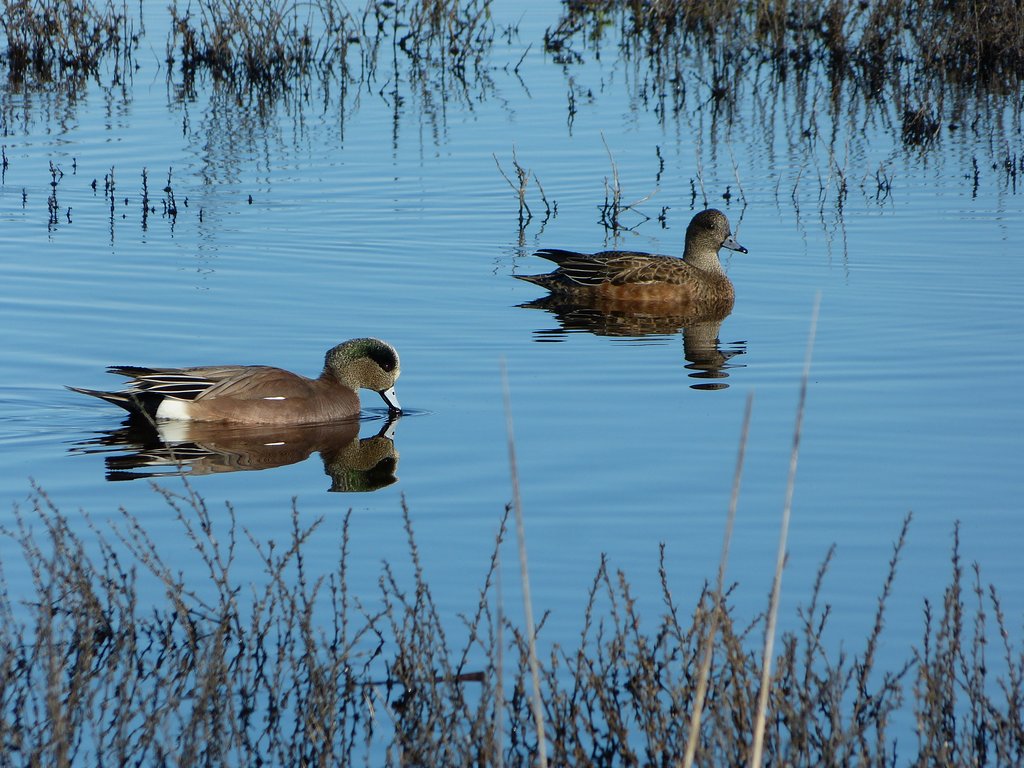
Camera. I have started using a camera in recent years. This can be a big ticket item, but you can buy used gear to soften the blow. I have birded for many years without a camera, but where it really helps is to identify species that look very similar. Often, you have a few seconds with a bird, so the camera gives you time later to study its features. I find it especially useful for sparrows. Luckily, they stay still just long enough to get a photo. Perhaps if I knew more about their calls and behavior, I would not have to rely so much on a still photo to tell them apart. The camera I use is a point-and-shoot with 24x optical zoom (25-600 mm equivalent of 35 mm) that I purchased for $80 at the local camera shop. It was probably 9 years old when I bought it, but it works for me. All the images you see in this post were taken with this camera.
Bird tourism
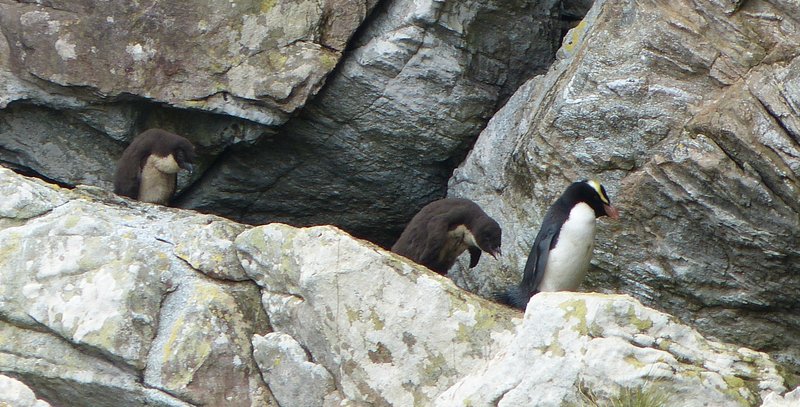
The wonderful thing about birding is that you can do it right where you live. Sometimes, though, you have to go where the birds are. My wife is a casual birder at best, but she likes to travel. Taking a trip to see birds gives us something to do together. This winter, we drove to the central valley, which is along the Pacific Flyway, a major migratory path. We went there to see Sandhill Cranes, which are one of the most ancient species in North America. Luckily, we were able to spot them, as well White-Fronted Geese, Snow Geese and Pintail ducks. On our recent trip to New Zealand, one goal was to see penguins out in the wild. That was a thrill. It made me appreciate all the birds I could see at home, and made me want to spend more time with them. Next, I would like to see wild California Condors…
Conclusion
I hope more people take up this hobby. Birds are fascinating creatures that are entertaining to watch and learn about. Birding gives us an incentive to go where the wild things are and be immersed in their world. If more people take up birding, we would take better care of the environment. I want birds and other wild creatures to live on, so we can continue to enjoy being in their presence.
Visit my Printify shop for prints of my best bird photos.
 Misanthrope Hobbies