
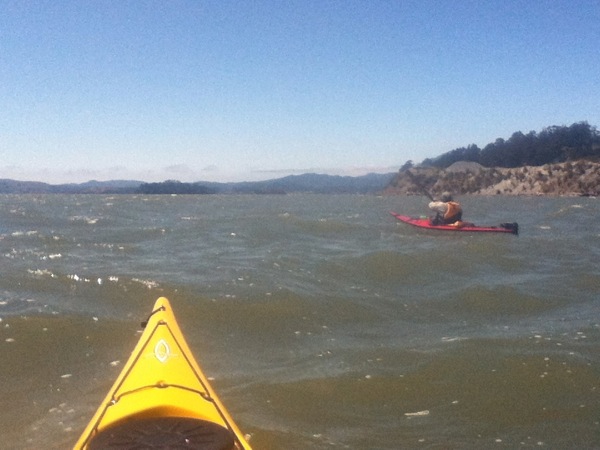
Over 27 years of sea kayaking, we never got into deep trouble. There were a few times when things got challenging, though.
Monterey microburst
I had been to Monterey, CA on a guided whale watching trip, and it seemed like a trip I could safely do on my own. We did not see any whales, so I wanted to try my luck again. I paddled out past Pacific Grove and Point Piños into the open Pacific on a pleasant day. Suddenly, the sky was darkened by a cloud out of nowhere, accompanied by intensifying rain and wind. “I don’t want to get caught out in a squall,” I thought. Being solo was a factor in how quickly I was overcome by fear. My arms felt like rubber bands and my stomach filled with butterflies. Each passing wave seemed larger than the last; I felt like I could capsize any second. Turning around, I paddled with haste, but it seemed like I wasn’t making any progress. Out in the ocean, the grander scale makes progress harder to notice. There was no choice but to keep paddling. Luckily, the cloud blew away as quickly as it blew in, but I had learned my lesson and returned to calmer waters in the bay. I didn’t want to deal with another burst of weather that day. When you are alone, you need to be aware of conditions at all times, be it weather, currents, boat traffic, aquatic life, or your equipment. I have rarely felt that sense of panic in my kayak, but when it happens, it is difficult to stop.
A real self-rescue
This was the one time I really needed a rescue. Having seen someone do almost supernatural feats with a Greenland paddle, I decided to make my own. Once it was finished, I couldn’t wait to try rolling with it. At this time, I was already a competent roller with my European paddle, so I set out alone in calm, protected waters. Making sure the water was deep enough to roll in, I set up and flipped over. I rolled halfway up and fell back in. That was a surprise. Undeterred, I set up again. Same result. At least it was repeatable. At this point I knew I wasn’t going to roll up, so I wet exited. There I was, in the water, by myself. It was not where I expected to be. I could hear kids playing in the skate park at the water’s edge, but there were no other boaters. I had a pump and paddle float with me, and I was wearing my wet suit. My first instinct was to get back in the boat as quickly as possible, so I righted my kayak and scrambled onto the rear deck. Then I slid toward the cockpit like a worm and plopped my behind into the seat. I had successfully executed a scramble, or cowboy rescue. I pumped most of the water out of my cockpit and paddled back to shore.
What I didn’t know up front was I needed to modify my rolling technique with the Greenland paddle. It doesn’t have the sheer power of the European paddle, so the roll is done more slowly and my body movements had to be more coordinated. It did not take long for me to re-learn the roll later on with a spotter around. Getting into trouble on my own was definitely a sobering experience, but thankfully my training held up.
Winter storm paddling
We are usually fastidious about checking the marine forecast before a paddle. I’m not sure what happened this time, but we launched in some winter weather at Ferry Point in Richmond. We were running with the wind at our back, so it did not seem so bad to me. The waves were steep, and they were fun to surf. About 15 minutes in, my friend told me that he thought we should turn back. Our unspoken rule was to always honor someone’s wishes to turn around. When we did, I felt the full force of the wind. Waves had now steepened to 3 feet, which is unusually tall for that part of the bay. Fortunately, they were not breaking. We were at the Chevron wharf, which was normally a 15 minute paddle back to the launch site. It took us 45 minutes, a good long time to reflect on the situation. It pays to think about the direction of the wind or current you are paddling in, and consider how they will affect you in the return direction. I was just enjoying surfing, but luckily my friend was paying attention. It’s better to cut a paddle short than to get into deeper trouble. Had the conditions been too much, we would have had to try to land elsewhere and wait out the weather, or try to get a ride to our vehicle (this was before the days of ride sharing and smart phones). When planning a trip, it is good to have a plan B, in case conditions are not in your favor.
Angel Island ebb currents
Four times a day, the Golden Gate plays host to strong tidal currents, which are also felt around nearby Angel Island. Angel Island is a beautiful destination, which can be reached from Point Richmond after an hour-long crossing. One time, we landed to have lunch with a beautiful view of San Francisco. By the time we were ready to leave, the ebb current was so strong that we delayed our return trip. It would have carried us away from our destination and made for a much longer return trip. We waited at least an hour that day for the current to abate. Luckily, it was a pretty nice spot to wait.
More recently, we made the same crossing, also during an ebb current. This time, we thought we were far enough from the time of maximum current to make the crossing. We did fine at first, but then we encountered a strong head wind past the shadow of the island. Combined with the ebb current, it felt like we were treading water. My friend confirmed this by looking to the side and using transits. We both started questioning our decision, and thought of turning back gnawed at us. The current held us for about 15 minutes, but we had managed to traverse its strongest flow. It was as if someone had cut a tether, and we were able to make forward progress again. We had not anticipated fighting both the current and the wind. This is a case when a brief sprint would have paid dividends.
San Quentin head winds
There is a nice beach near Point San Quentin at the base of the Richmond-San Rafael bridge in Marin County. From there, we paddle past the Marin Islands, around Point San Pedro, past The Sisters, towards China Camp State Park. More often than not, the return trip involves a strong head wind from Point San Pedro to our launch spot. We try to stay in the wind shadow of the Marin Islands to save energy before crossing the final stretch of open water. Recently, we were facing 15-20 knot winds, stronger than expected based on the weather report. It took us a long time to make it to the Marin Islands, and the final stretch was just plain fierce. I really didn’t have another gear, and I thought my friend must be tiring, too. We had to fight for every foot of progress, and if we stopped paddling, we would immediately blow backwards. We had gotten within a few hundred yards of our launch site, and I noticed that a gap had opened up between me and my friend. He looked like he was struggling. I paddled back to him, and he told me that he was having trouble pointing his kayak into the wind. This was bad news. We had already lost a lot of ground, and I worried about how much either of us had left in the tank. I told my friend I wanted to tow him, and of course he balked at it, like everyone does. With the tow line pulling his bow in the right direction, my friend would be able to paddle forward instead of making constant course corrections. Given the situation, I insisted on towing. Once we made it near land, the wind died down and I was able to unclip the tow rope. I am not sure if we would have made it back without the tow, but it was the most tired I’d ever felt after a paddle.
Conclusion
Even if you plan your route and do your due diligence with the weather and current predictions, things can become more challenging than you expected. That is why you learn and practice rescue skills. This goes triple if you paddle alone. Without other eyes and ears around, you really need to be on top of the situation at all times. Let’s be safe out on the water.
 Misanthrope Hobbies