
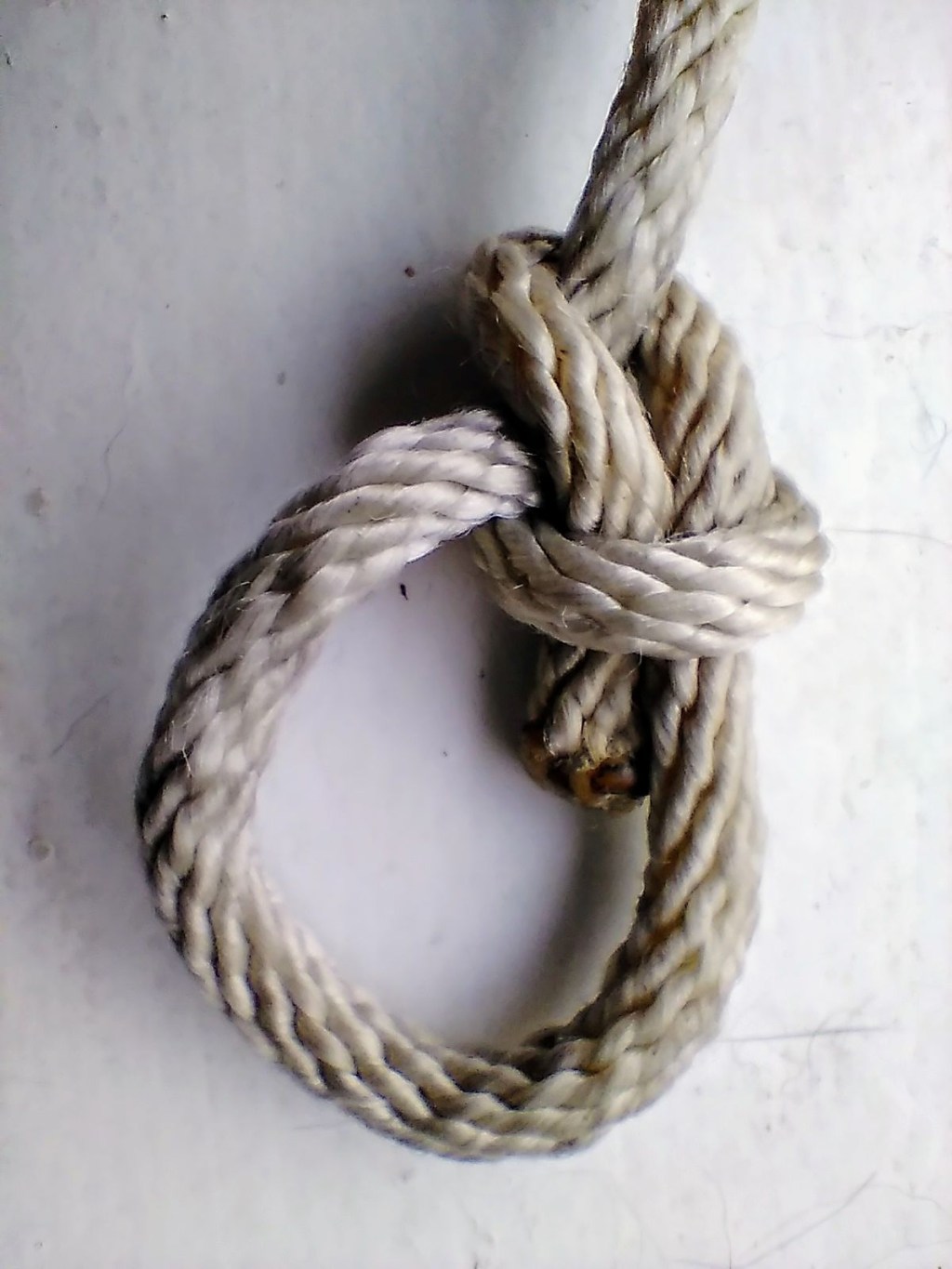
Before we had cheaply manufactured carabiners, zip ties, and velcro at our disposal, the world relied on cordage and knots. The good news is most of us know at least one knot for tying our shoe laces. Then, perhaps a simple overhand knot, like the one you tie at the end of a rope to prevent fraying. After that, we are probably nearing the limits of common knot expertise. I remember my parents would just keep tying the same knot over and over, until it “felt secure.” Unless we have taken outdoor education, or have an innate interest, most of us don’t think about knots. It helps to know a few useful knots when the need arises.
Why learn knots?
A sense of security – It’s nice to know that a knot won’t accidentally come loose under load. We all have seen mattresses on the highway. I always wonder how it was secured before it took flight. A proper knot will behave predictably, provided the rope is strong enough (a knot reduces the strength of rope by 50%).
Easy to undo – Tying a proper knot means you can untie the rope after you are finished with it. For example, the bowline knot is renowned for its tendency not to bind.
Problem solving – There will be times when all you have is cordage, and knowing knots will enable you to improvise a solution. For example, you need to secure a package to your bike rack, but don’t have a bungee cord. In this application, a tight rope is more secure than a stretchy bungee, anyway.
It’s fun and relaxing – I am the only person I know that can spend an evening practicing knots, but I must not be alone. It is very satisfying to tie a knot correctly and see how it performs. It takes practice to remember these knots; I have probably forgotten as many as I know.
Examples of knot use

Bow line for car topping a kayak – The kayak is strapped on to the roof rack with heavy duty cargo straps, but it is best to have a backup bow line, in case one of the straps comes loose. One end is tied to a towing point using a bowline knot. The other end is tensioned using a trucker’s hitch.
Eyeglasses retainer – I have used these for 20 years, and they have never failed. The frame is secured using buntline hitches, and the strap is tightened using a quadruple overhand knot as a friction lock. I learned this from the defunct Sea Kayaker magazine. The more dirty and sweaty this gets, the better it functions.

Pitching a tarp – 5 points of the tarp are secured by a slip knot around a wooden bead inserted in the tarp. This is stronger than grommets. A bowline knot is used to form a loop on the other end for stakes. The peak is fastened to a pole using a clove hitch and staked out in from with another bowline.
Uses of a knot
These are ones that come to my mind; there are lots of other uses that humans have devised!
Forming a loop – You can secure an object by tying a loop through a ring or eye, like on a D-ring. This also makes it easy to stake down a line. When using regular rope (not fishing line), the bowline is the king of loop knots.
Joining two ends of a line, or two lines – Let’s say you have two lengths of line that you want to join to make a longer line. To complicate matters, they are two lines of different thickness. The sheet bend is what I rely on for this job, but there are many types of bends.
Tensioning a line – Perhaps you want to take the slack out of a clothes line, or add guy lines to bolster your tent in high winds. For me, the trucker’s hitch is my go to knot for this application. It consists of a slip knot to act as a pulley, and a half hitch to secure the knot.
Making fast to a post – This would be for tying off a horse, or a boat. The clove hitch is the knot you would start off with, as it is the basis for related knots. The aforementioned buntline hitch is just a clove hitch tied onto the standing end of the rope.
Whipping/wrapping – Whipping knots are used to bind the ends of large ropes so they do not fray. They can also be used to wrap the handle of a tool, like an ax or a knife.
Slip knot – A simple slip knot can be used as a simple noose (as in my tarp example), or as a quick release. It is common to add a slip knot to a well known knot, like a bowline or clove hitch, so it is easily released. These are called “slipped” versions of knots, and are well worth knowing.
Weaving/decorative – A relatively popular hobby is paracord weaving to make survival bracelets and such. There are also decorative knots like the Turk’s head knot and the monkey fist. Macrame would also fit into this category. If you have excess cord, it’s nice to be able to weave it into a more compact lanyard.
Learning to tie knots
There are lots of online resources to learn knots these days. To start, I would recommend the Animated Knots page, and good old Wikipedia. There are also tons of YouTube videos. If you run into difficulties, keep searching for instructions that work for you. Sometimes one person just has an explanation that makes sense.
There are subtleties about tying knots. Twisting clockwise or counterclockwise, laying a line in front or behind its standing end, makes all the difference in tying a knot correctly. Your finished knot should match its photos. It should not collapse, i.e., when you pull on both ends of the rope, the knot should not change shape. If it does, it means you missed a detail somehow. This is normal, just review the instructions and keep trying.
A fid is useful for undoing knots. It is a piece of wood or metal with a pointed tip used to force open a tough knot. Folks often use the corkscrew on a Swiss Army knife for this purpose, but you can carve one out of a stick, or take a nail and sand off any sharp edges.
Recommended knots
These are 10 knots to get you started. I hope you get hooked and explore on your own. There are more cool and useful knots to learn!
| Knot | Uses | Links |
| Bowline | Forms a loop at the end of a line; easy to undo | Animated_Knots Wikipedia |
| Slip knot | Forms a temporary loop; unties itself under tension. Can cinch around an object. Used in the Trucker’s hitch. | Animated_Knots Wikipedia |
| Trucker’s hitch | Adds tension to a line. Tie down loads, guy lines, etc. Note: the animated knots site shows a figure 8 loop instead of a slip knot for a pulley. | Animated_Knots Wikipedia |
| Clove hitch | Tie a line to a post or shaft; grips under tension, easy to undo. It is the basis of other knots | Animated_Knots Wikipedia |
| Sheet bend | Joins two lines, especially of two different diameters. Related to the bowline. | Animated_Knots Wikipedia |
| Figure 8 knot | Used as a stopper knot. Easier to undo than an overhand knot. Also the basis for loops and other knots. | Animated_Knots Wikipedia |
| Fisherman’s knot | Forms a neat loop out of a piece of cord, or joins two lines; easy to tie, but tends to jam. Note: Animated Knots shows a double fisherman’s knot, which is also good to learn. | Animated_Knots Wikipedia |
| Butterfly knot | This is the best knot, IMO, for making a loop in the middle of a line. It is easy to undo. | Animated_Knots Wikipedia |
| Canadian Jam knot (Arbor knot) | Use a rope as a compression strap or lashing. Originally for tying fishing line to a reel. Can be released and tightened over and over. | Animated_Knots Wikipedia |
| Common Whipping | Wrap the end of a rope to prevent fraying; wrap handles with cord | Animated_Knots Wikipedia |
 Misanthrope Hobbies