These tips will help you make the most of your next time out under the stars.
View objects when they are highest in the sky
When we look straight up, we are looking at the zenith, which minimizes the amount of the earth’s atmosphere we are peering through to outer space. This is a good thing, because our atmosphere has moving air currents. An object near the horizon is likely to be blurry, since it maximizes the volume of air we need to look through. The seeing refers to the quality of our view due to air movement. If you have seen mirage boiling off a hot road, you know what poor seeing looks like.
The meridian is an imaginary arc, drawn between north and south, passing through the zenith. Each longitude has its own meridian. Objects are highest in the sky when they cross the meridian, so plan your observing session accordingly. For deep sky objects, you can use a planisphere to determine when objects will be near the meridian. Solar system objects require other means, like a finder chart or app. I usually use my astronomy app to decide when best to view a planet. You will find that sometimes, you’ll have to stay up late to get the best view. I have lost a bit of sleep, but it has been worth it.
Looking through as little atmosphere as possible also improves your chance of seeing faint fuzzies, like galaxies or nebulae, because water vapor reduces contrast. There is also less dust and air to scatter local light pollution.
Use averted vision
For objects with low surface brightness, using averted vision may be the difference between detecting it or not. Our eyes have the most rods right off the center of our eye. Rods will not show color, but are great for detecting dim light. This means you can detect fainter objects if you look slightly to the side. Averted vision will also help you see subtle detail and structure in objects like the ring nebula. It is not natural to use averted vision, so remind yourself to do it when observing or sketching deep sky objects (DSO).
Protect your dark adaptation
It can take your eyes up to 30 minutes to adapt to the dark. This process is known as dark adaptation, which is a must for detecting faint objects. Once your eyes have adapted, do not spoil it with bright light. If you need a flashlight to read a star map, or move about, use a red flashlight, which will not hurt dark adaptation. Use only as much light as you need to read the map. I tape over a weak flashlight with scotch tape and color it with a red permanent marker.
A jacket or sweatshirt with a hood is a good tool for observing in areas with street lights or lights from a neighboring building. Not only will it help preserve dark adaptation, it also prevents outside light from reflecting off your eyepiece.
It might help to make some type of panels to block nearby lights. It makes all the difference to have some darkness. I did this with some tarps and bamboo stakes, which worked great until neighborhood cats started spraying it.
The Moon
The moon is a source of light pollution. It will make it much harder to see DSOs. When hunting faint fuzzies, plan to do it on a moonless night, before the moon rises, or after it sets.
If you are actually observing the moon, the best place to see details is near the terminator, which is the transition between light and dark on the surface of the moon. To think of it another way, it is sunrise at the terminator. As we know, shadows are the longest at sunrise and sunset, due to the low angle of the sun. These shadows give definition to craters, mountains, rilles, and other lunar features. During a full moon, some features are impossible to see due to the flat lighting and lack of shadows. The terminator traverses the moon twice during its cycle as it waxes and wanes. A book like Discover the Moon by Legrand and Lacroux will show you the best days to observe a particular feature.
Observe planets at opposition
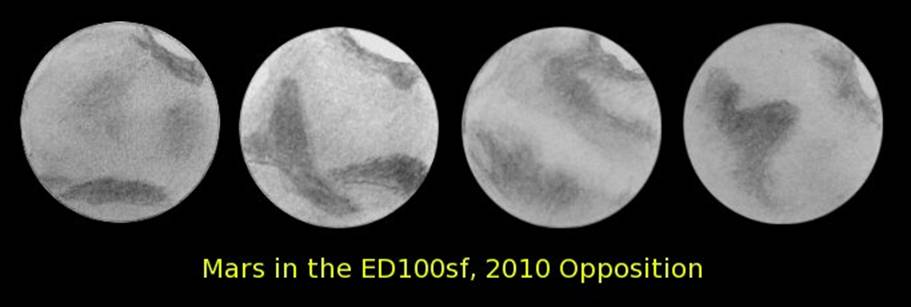
Mars, Jupiter, Saturn. These are the showpiece planets in our solar system for observing. Because they are further from the sun, they can come into opposition with earth. As the planets orbit, there is a time when the earth comes between one of these planets and the sun; this is called opposition. At opposition, a planet is closest to earth, so you can see the most detail. The best planetary observing is done within a month of opposition. Each opposition is different; the distance to earth varies (therefore the apparent size), and the elevation varies as well.
For example, the 2022 opposition of Jupiter was the closest it has been since 1963. It occurred on September 26th in the constellation Pisces, and was 52 degrees above the horizon at the latitude of the San Francisco. At a distance of 3.95 AU (astronomical units), its size was 48.8 arc-seconds. The next opposition of Jupiter will occur on November 2, 2023. It will be 65 degrees above the horizon in the constellation Aries. At a distance of 3.98 AU, its size will be 48.4 arc-seconds. Even though Jupiter is a little further away in 2023, it might present better viewing because it is higher in the sky.
Use the Clear Sky Chart
To decide if the weather is good for observing, I use the Clear Sky Chart. You can search for a location nearest to where you are observing in North America and bookmark it on your browser. If there is nothing within 15 miles, you can request your own chart… how cool is that? I mainly use the Cloud Cover and Transparency predictions. The cloud cover is exactly what it sounds like, while transparency is based on the amount of water vapor in the atmosphere. I don’t use the seeing predictions much, because air turbulence can be localized, like heat radiating off your neighbor’s roof. The darkness chart takes into account the brightness of the moon, which can be helpful.
Mind your tube currents
If you store your scope indoors, chances are it will take some time to cool down outside. While it does, tube currents, turbulent air inside your telescope, will degrade your view. It’s not a big deal, but your best high power views will come after this issue subsides. This is probably more an issue for enclosed scopes, like refractors and catadioptrics. If you can set your scope outside or in an unheated garage for 20 minutes before you start observing, you can skip the equilibration time.
Patience is a virtue
Astronomy rewards patience, both at the eyepiece, and over the years. Taking the time to look for detail is something that has to be learned. Sketching is an exercise that is not so much about producing art, but improving your observing skills. If you try to draw a person, it’s natural to scrutinize their features a second, third, or fourth time to render it accurately. It is the same with sketching at the eyepiece.
I have spent 30 minutes or more just looking at Jupiter. I move my scope so the planet drifts from one edge of my eyepiece to the other, which takes about 40 seconds. Reset, and repeat. There are moments when the seeing calms down and details come into sharp focus, for a split second. Did I see what I think I saw? I wait for the next moment of clarity to confirm.
As you gain experience looking at dim objects, they will become more obvious to you. At some point, you will be able to see things a beginner cannot. This reflects the growth in your observational skills, which is more satisfying that constantly buying equipment.
Conclusion
Astronomical observation is an activity based on skill. Of course, you need clear optics, but the limitations lie within the observer at the beginning. I hope I have been able to share a few tips to help you grow in this great hobby.
 Misanthrope Hobbies