
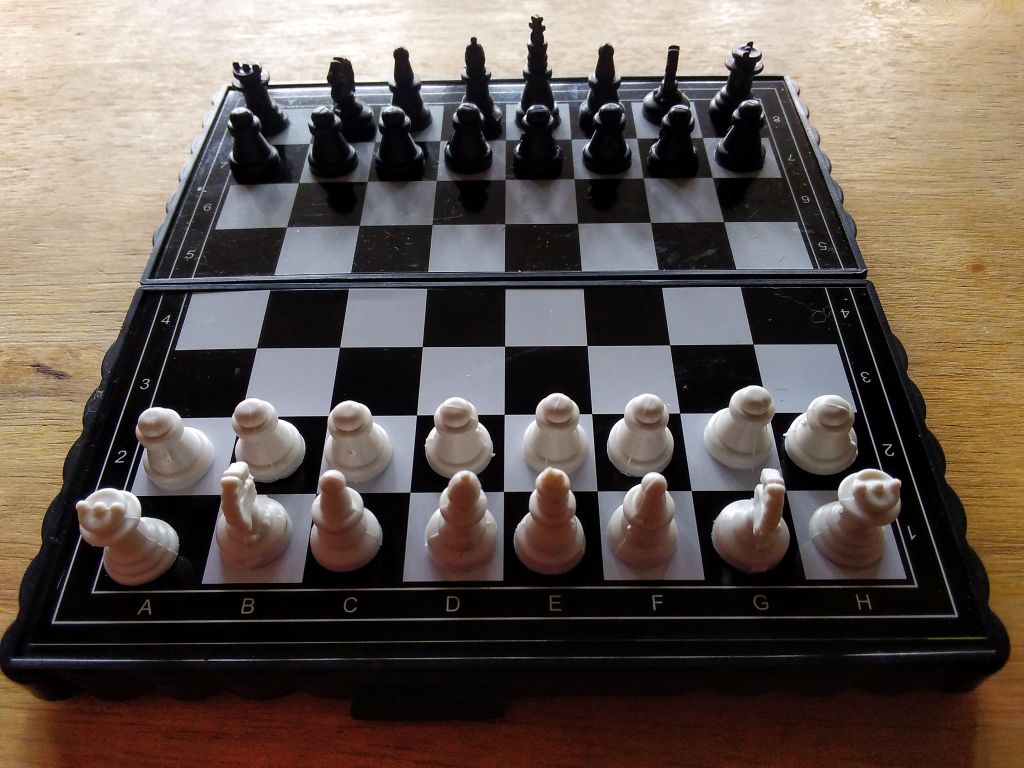
I love to play chess. My father taught me the Chinese version when I was a boy. As a child, beating a grown-up was the ultimate thrill. I joined the chess club in high school but I wasn’t very good. That was when humans were still better than computers. Nowadays, chess is having a resurgence with the Queen’s Gambit series on Netflix, and live streamers with legions of fans. I mostly play on Chess.com with friends. As I get older, I am counting on chess to keep my mind sharp.
Why chess is great
Chess is not a game of chance. That is a turn-off for some folks, but not me. I like that the outcome of a chess game is only determined by your choices and your opponent’s choices. There are just rules and logic. If only the real world made such sense. There is something about playing a live human: the war of wits, anticipation of the next move, looking hard for something your opponent missed. Playing a live match gets the heart and mind racing.
There is a finite number of moves on the 8 x 8 board, around 1040. For a mere mortal like me, that number might as well be infinity. Given the number of choices, your moves are an expression of your personality and creativity. Some people are aggressive, some are reserved, others somewhere in between. While I always try to anticipate the next move, often I am completely surprised. That is what makes chess fun.
Chess teaches important lessons for life. You learn to consider the consequences before you move. A good player will think a few moves into the future, anticipating opportunities before other players do. You have a finite number of resources: 16 pieces in total, each with its own abilities. You decide when to put them in harm’s way, whether to keep or trade them, and when a sacrifice will secure victory. Good chess requires coordination of your pieces, so that one supports the other. Over-extend yourself, and your opponent will win a piece. Play too conservatively, and your opponent gains the initiative. Assessing the situation, forming a reasoned plan, and adapting to surprises are all skills worth developing in life.
Is chess a reflection of your intelligence?
Not more than anything else is. People who are good at chess are just that: good at playing a game. Chess has a set of rules, strategies, and tactics with its own learning curve. Over the years, players have developed and analyzed different openings, a set of moves played at the start. An ambitious player will memorize the main lines of several openings, to pounce on mistakes if their opponent misplays the opening. There are also well known traps that you can set for the unwary player, some of them leading to a fool’s mate, a checkmate in minimal moves. Studying the game is fun and helps you win, but it doesn’t mean you are smarter than the person you defeat. Some people avoid playing chess because they take losing as a reflection of their intelligence. It really isn’t.
Getting better at chess
I would say my rating is around 1400, which is not a beginner, but not impressive, either. This is because I can beat a 1300 bot regularly, but seldom a 1500 bot. I’ve come a long way since I was a beginner; these are things I did to progress.
Figure out your opponent’s plan – This is what I need to work on right now. I get so enamored with my own plan, that I am blind to what my opponent is intending. Sometimes they are one step ahead of me, and I am lost before my grand plan plays out. Having the discipline to look across the board and put yourself in your opponent’s shoes will really improve your game. Being able to recognize a checkmate threat and defend against it is a key milestone.
Keep playing – The person I played the most was an ex-coworker of mine, who has a very aggressive style. My tendency is to slowly build a defense, but his headlong attacks always threw me off balance. Eventually, I adapted and learned to exploit the openings created by his aggression. I knew that if I could survive his first onslaught, my chances of winning were good. On the other hand, playing against passive players helps you develop your attack. They give you time to identify a weakness and execute a plan. You can play people from all over the world online, so there is no shortage of competition.
Solve puzzles – I mostly use Chess.com, but there are plenty of other sources, such as lichess.org. Chess.com gives you 5 free puzzles a day, which is sufficient for me. A puzzle is a scenario in which you can employ a tactic. A chess tactic is a series of forcing moves by which your opponent loses a piece, or the match. When I first started, I had zero clue why a certain move was correct. After some time, things began to click, and I was able to solve tougher puzzles, which require you to think more moves ahead. Chess puzzles can be very humbling, but will make you a better player if you persist.
Watch videos – We live in a golden age of free information. There are lots of great chess channels on YouTube. To learn different openings, I like videos from thechesswebsite. Their videos get straight to the point, and don’t overwhelm you with a ton of variations. By far, my favorite is Mato Jelic’s Chess School. Mato’s videos are short and instructive, with a cheeky sense of humor. Mato analyzes past games without overwhelming you with every detail. Instead, the match is narrated like a sporting event, only delving into key decisions, especially the “most critical position of the game.” If you watch enough videos, the openings will become familiar, as will common tactics and strategy. Mato’s very entertaining series on Mikhail Tal is where I learned about sacrificing pieces. There is a decade’s worth of videos on the Chess School channel, and all the great players are represented. It is a substantial treasure.
Playing against bots– A bot is very consistent, more so than a person. While it is not as exciting to play as a person, a bot can expose weaknesses in your game. I tend to miss checkmate threats, and tactics involving a knight. To beat a good bot, I need to play my best chess, which is good practice for facing humans who are ranked higher.
There are books, coaching, and other resources available; these are just the ones I use. A special note for brand new players: learn what castling is, and when it can’t be done, as well as how capturing a pawn en passant works.
Conclusion
I strongly encourage you to give chess a try. It offers a rare chance at quiet concentration in our fast-paced world. Sometimes, a well contested match can be the most exciting event in your day. With all the resources available today, nurturing your interest is easier than ever. All this learning and thinking, I believe, has to be good for your brain.
 Misanthrope Hobbies