

Note: the knives you see have been significantly modified; a brand new Svord Peasant will look different.
“There is beauty in simplicity,” the saying goes. For a knife, simplicity is utility, strength, and reliability. The Svord Peasant knife is based on an Eastern European design from the 1600’s. Made with modern materials in New Zealand, it is a resoundingly simple folding knife. There is a blade, two handle scales, two Chicago screws, and a stop pin. No springs, bearings or locks. This type of knife is called a friction folder, because it relies on friction to keep it open or closed. This anachronism is unfamiliar, so people avoid it, or give it bad reviews. Why should anyone like it, then?
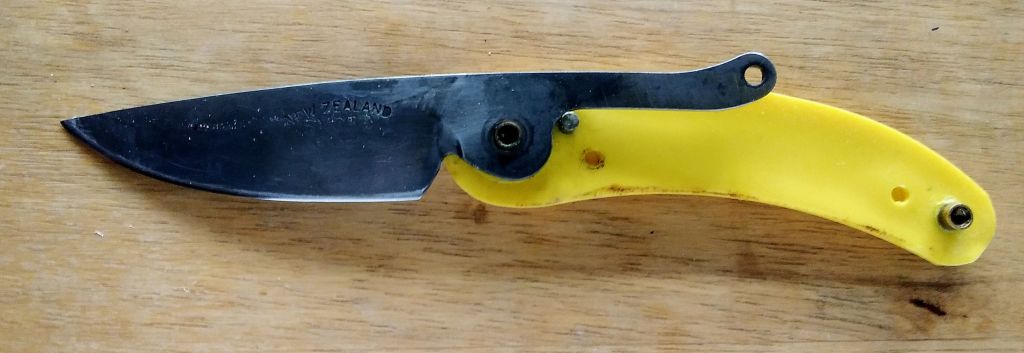
The blade
The blade is made of carbon tool steel and is 3.25″ long, good for general use. Mine is an older model, made from L6; newer ones are made of a similar steel, 15N20. I can get my Peasant knife razor sharp using basic tools, like ceramic rods and inexpensive stones. In fact, it is one of the sharpest knives I own. In a pinch, I can sharpen this knife on a river rock, the bottom of a mug, or the edge of a car window. The flat grind and 2 mm blade stock makes it a very good slicing knife that does well in the kitchen. I have modified my blade by removing material from the edge, near the tip. There was a pronounced “belly,” which I turned into a more gradual curve. For my needs, this improves the all-around performance of the knife.
Carbon steel will rust, so you need to dry the blade after use. You can also apply a thin coat of oil if you wish. Over time, carbon steel will develop an oxide layer, called a patina, which helps prevent rust. Cutting acidic fruit will help force a patina, as will contact with mustard and vinegar. A patina will also reduce the taste of carbon steel when you cut food with this knife. For a brief time, there seemed to be a stainless 12C27 version, but now it is never in stock.
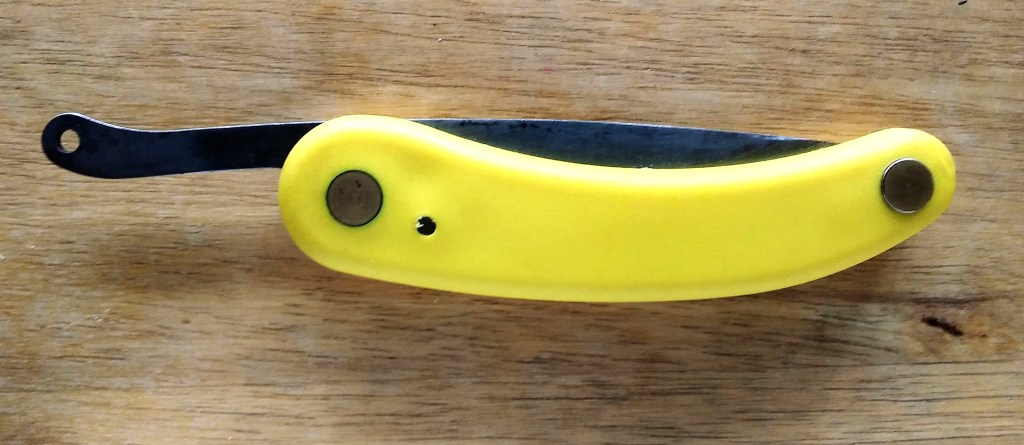
What is that protrusion at the end of the blade? That is called a tang. It helps you open the knife and keep it open. In most grips, your palm will hold the tang down and prevent accidental closure. This is a very safe knife if you don’t do silly things with it. Some people find the added length of the tang off-putting, which I understand. I look at it as another tool. You can use it as a letter opener or a pry bar. You can lever open bottle caps with it, or use the hole for a lanyard. A nifty trick I have seen is to wrap a cord around the handle and through the hole in the tang, locking the knife open. An added bonus of the tang is it props the knife up vertically in your pocket. Most pocket knives will lay horizontal, which tends to protrude and compete for space with your keys.
The handle
Made of plastic or wood, the handle has some curvature, but is otherwise neutral. It doesn’t have grooves that lock your hand in a specific grip. For a general purpose knife, I like the flexibility to adopt different grips for the task. This is especially true in wood carving, which is common in wilderness living/survival skills. This is a comfortable handle that will not cause blisters or cramps during prolonged cutting. I cut off the pointy tip on my handle, because I did not like the added length, or the prospect of wearing a hole in my pocket. Some models have very thin metal scales for a handle. I would avoid these if you anticipate cutting for any length of time, as they are uncomfortable to bear down on.
The choice of handle materials also means the knife is very light. My full sized Peasant weighs 2.5 oz. For a 3-1/4″ inch folding knife, that is featherweight. You can carry it all day and barely notice it is there.
Opening and closing
Probably the most common thing people get wrong is the opening/closing of the blade. Understandably, they try to open it like something they’ve used in the past, either like a Swiss Army Knife or a one-hand opener with a hole or thumb stud. Neither way is likely to work well, resulting in frustration. The key to opening/closing this knife is not to pinch the scales. You are just fighting against yourself if you do.
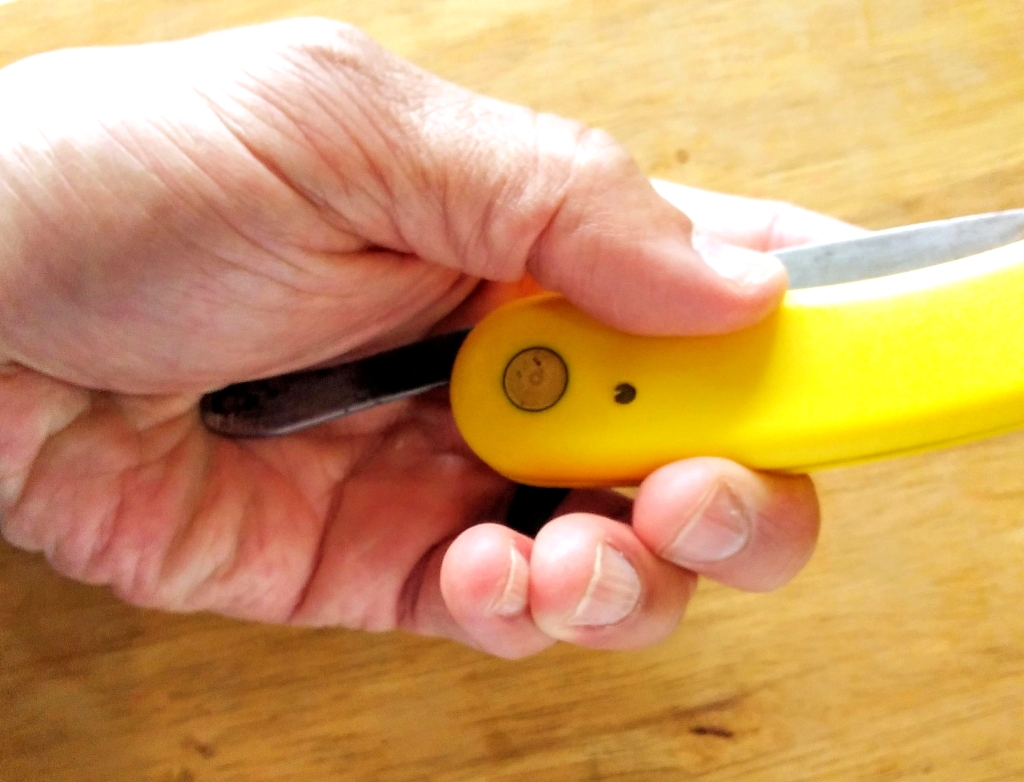
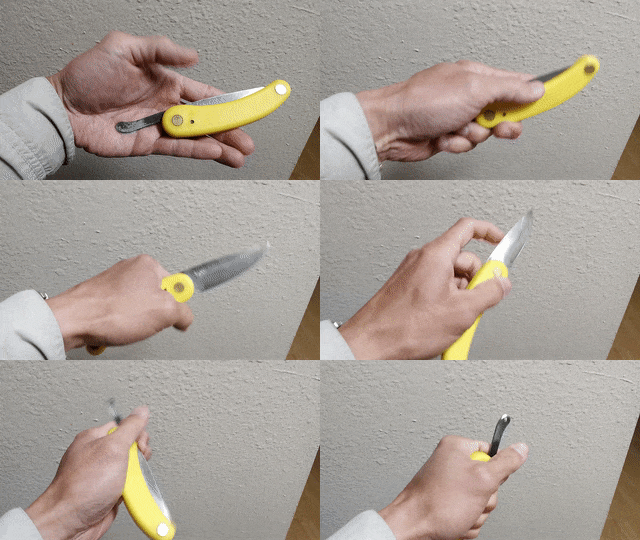
To open the knife with one hand, hold the knife as shown above. Your hand is positioned as if shaking hands. The tang is held against your palm, about 2/3 of the way down. Press down on the handle with your thumb and index finger, and the knife will pop open. Grip the handle with all four fingers; that’s it. With a little practice, you can open the knife in the same motion as taking it out of your pocket. This knife opens as quickly as anything else I own.
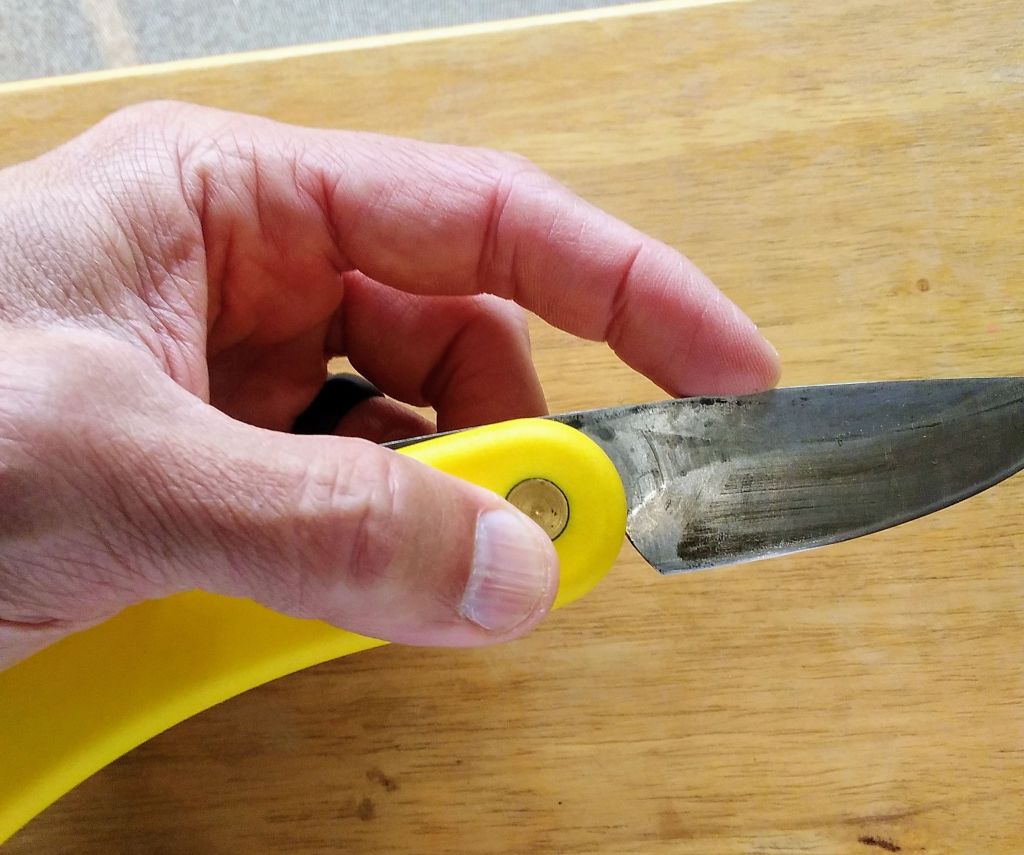
To close the knife, hold it close to the pivot, so not to pinch the scales. Press down with your index finger to close the knife. In the beginning, the tang will probably bump into the web of your hand. With practice, you will find the best grip to avoid this. This is a very easy knife to operate if you know the right way.
Tuning the screws
Each Chicago screw has its impact on how the knife operates. The pivot screw controls how easily the blade rotates. I like to have a little bit of resistance so the blade can’t spin freely. The rear screw controls the retention of the blade when the knife is closed. People worry the blade will accidentally open up in their pocket, which is unfounded. You can tighten the rear screw until you are certain the blade is secure. I carried the Mini Peasant for a year in my left front pocket. I rode a bike to work daily, lifted things, bent over, kneeled down, and it never, not once, opened by itself.
It’s tough
Simplicity makes this knife strong. It would take a lot of force to shear apart the Chicago screws, or tear out the stop pin. I’m sure it can be done, but not during normal cutting. I abused the Mini Peasant by using it to cut branches from, section, and split a dry hardwood branch. This took lots of hits with a baton. The Mini Peasant is still with me, and it works like new. Even if the handle were to shatter apart, simply lash the tang to a piece of wood, and you’d be back in business. If I needed to rely on a folding knife to do a tough job, the Svord Peasant would be on my short list.
A legitimate issue
Out of the box, there was an issue with both my full size and mini Peasant knives. In the closed position, the blade would touch the rear Chicago screw. This causes a dull spot on the blade. Unless you were looking for it, you’d probably never notice it. For people who obsess over their knives (like me), this would keep them up at night. I am not sure Svord has fixed this issue, but it’s easy to find out by disassembling the knife.
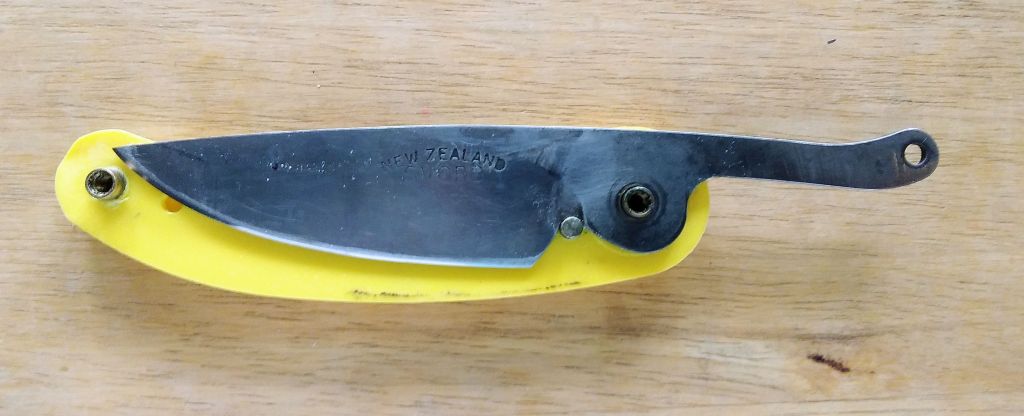
There are a few ways of correcting this, if you wish to. It’s a pain in the butt, but for an inexpensive knife, I can let it slide.
- Slide a plastic tube over the rear Chicago screw, which would dull the blade less. I suppose this is the easiest solution, but eventually, you’d cut through the plastic, and you are right back at square 1.
- Install a larger diameter stop pin. You can go to your local hardware store and ask if they have something off the shelf that is the correct size. Otherwise, buy a brass rod, or take a piece of coat hanger, and cut it to size with a hacksaw. You would also have to enlarge the holes in the scale for a larger pin. This is what I did.
- If #2 sounds like too much work, you might try putting a plastic sleeve over the stop pin to make it bigger. I have not tried this, but it might work.
- Reprofile the blade. If you remove some of the edge near the Chicago screw, it would no longer touch. This would require some expertise to reshape and resharpen the blade. It’s not rocket science, and can be done with a file and fine/coarse stone.
Conclusion
The idyosincratic, no-frills Svord Peasant knife is effective and easy to use. I bought mine for $15 ten years ago; as of this writing, it retails for $20. The folks at Svord have managed to keep the price low, and the functionality is as good as ever. You get a nicely tempered, tool steel blade in a solid package. The Mini is a great pocket knife if you find the regular size too large. Once you tweak it to your liking, the Svord Peasant knife is an all-purpose knife that will serve you well for a lifetime.
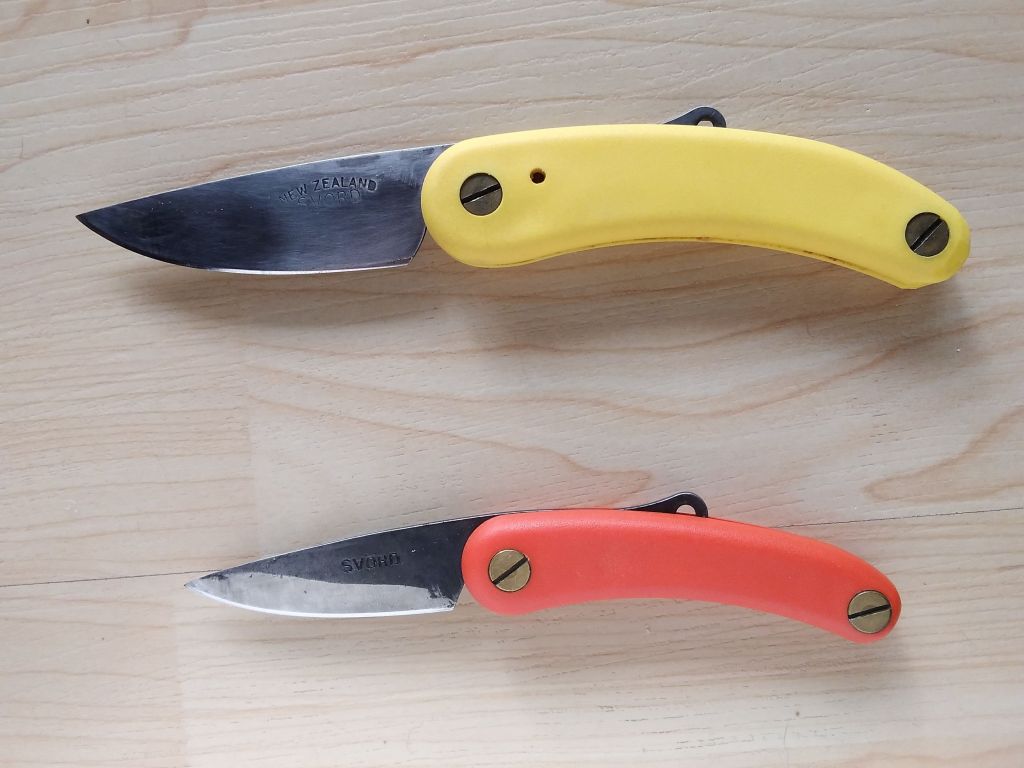
Svord Peasant (top), Svord Mini Peasant (bottom)
 Misanthrope Hobbies