
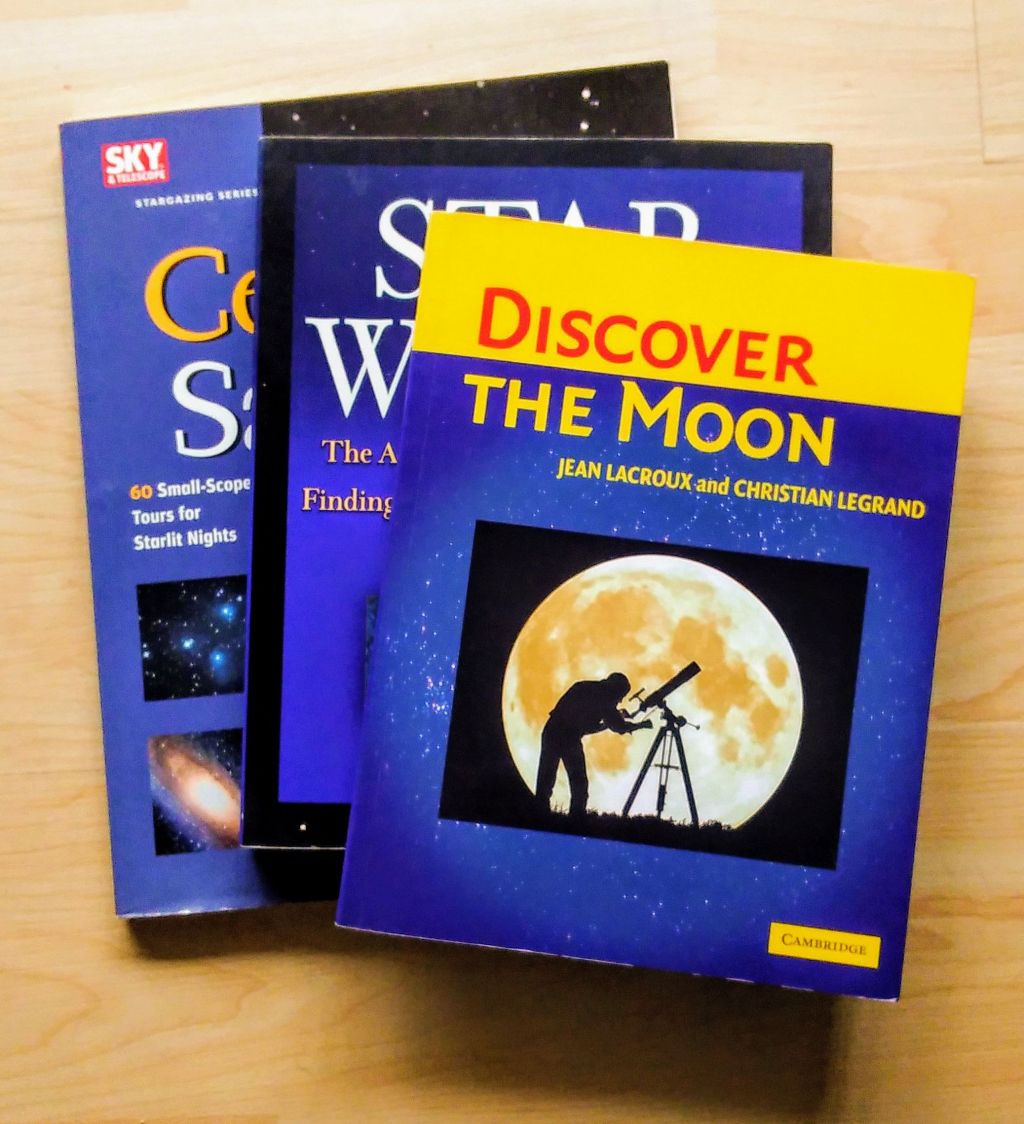
To learn more about this hobby, and to fuel your desire to pursue it, I recommend these following resources. I hope it helps get you off to a good start.
Binoculars
No need to buy a telescope! You can start observing with binoculars if you already own them. Finding objects with binoculars is a great way to help you decide if astronomy is for you. Google “binocular astronomy” and start hunting down objects. If you succeed, you are well on your way! If you fail, do not despair. It could be too light polluted where you are, or you might simply need to get better oriented with the night sky.
Astronomy app
There are many apps out there that simulate the night sky and are chock loaded with features. I use Stellarium, which is free. The main way these apps can help beginners is to learn the constellations. These apps are also primarily how I find planets, which change their position in the sky. You’ll want to go outside and start recognizing bright stars, and prominent asterisms (a group of stars that are part of a constellation). The best known asterism is the big dipper. It consists of the brightest stars of the constellation Ursa Major. If your phone has a compass capability, the app should just line up with where you are looking. Try to match the stars in the sky with the ones on your phone. My phone is cheap (no compass), so I need to know which direction I am looking. In the winter, you should be able to find Sirius, the brightest star in the sky (planets shine brighter, so be careful), and the belt of Orion. In the summer, try to find the summer triangle of Deneb, Vega, and Altair. There is so much fun to be had!
Planisphere
If you don’t want to mess with your phone, a planisphere is an old school tool to help you learn the night sky. They can be had for $10-$20. Purchase one that is suitable for your latitude. The planisphere has a printed map with a rotating window on top. Only certain parts of the sky are visible in any given season, and the planisphere makes this very obvious. Set the date on the rotating window, line it up with the direction you are facing, and it will show you the constellations and bright stars you should see. Knowing these is a must for manually aiming your telescope.
Sky and Telescope’s Pocket Sky Atlas
Showing more detail than a planisphere, this is a detailed star chart that you might need to locate some objects. Galaxies, nebulae, star clusters, double stars, carbon stars, and other objects of interest are labeled here. If you like maps, this is interesting to peruse in its own right. This atlas is the only tool I use to find what I wish to observe. More on how I use it later.
Books
Most of what I am telling you, I learned from these books.
Star Watch by Phil Harrington. If you get one book to start, this would be it. It covers all types of observing, and is supplemented by finder charts, photos, and sketches. Each object has a full description and is rated by how they look in different sized scopes. Phil is a great writer whose writing reflects years of experience and research.
Celestial Sampler by Sue French. While not as comprehensive as the previous book, this is a pleasure to read and use. It consists of “tours” organized by month. Each tour consists of notable objects for small scopes – perfect for the beginning astronomer. There are photos and finder maps that accompany Sue’s own observations for each object.
Discover the Moon by Jean Lacroux and Christian Legrand. If you want to try lunar observing, this is a great book to start with. It is organized in days of the lunar cycle, and it is illustrated mostly with photos, which is why I love this book. It is easy to use, and will keep you engaged for quite some time.
Star Ware by Phil Harrington. This is an encyclopedia on telescopes and accessories. You can pick this up later, as you contemplate buying more gear. It is not in my library any more, but I read it cover to cover to kick start my knowledge on equipment.
Magazines
Not a must, but you may want to subscribe for a year. After that, things might get repetitive. There are two main publications: Sky and Telescope and Astronomy. They are both good, but I seem to go back to Sky and Telescope’s website over the years. Magazines are good for catching up on the status quo of the hobby and professional astronomy.
Cloudy Nights online forum
I used to frequent and participate at Cloudy Nights. When you are starting out, it’s a great place to ask questions and learn from others. There are lots of articles, reviews and galleries to peruse. Being able to interact with other amateur astronomers is very valuable, even though I am a misanthrope. I will caution that there is a bit of snobbery there, which is eventually why I left. There are people with fat wallets that buy gear more often than they use it. Try not to get sucked into that mentality; focus on the fun of observing and developing your skills.
Ed is a great guy with tons of experience reviewing scopes. I think I’ve read all his articles. He reviews the gamut from very cheap to very expensive scopes. I emailed him 15 or so years ago, and he told me that of all the scopes he owns, he uses his Orion XT8 more often than not. You see, a decent scope is all you need for observing.
Astromart
Astromart is a place to sell/buy/trade gear. Cloudy Nights also has a Classified section. I don’t believe you need a lot of equipment to enjoy this hobby, but if you start getting the itch to accumulate/try out different gear, buying used can save you lots of money. I have purchased telescopes and eyepieces from Astromart in the past. You will have to pay to join Astromart.
 Misanthrope Hobbies