
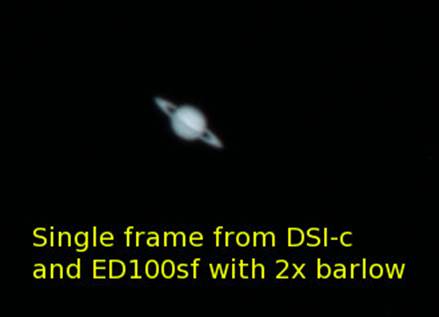
I don’t know of anyone who would refuse a chance to look through a telescope. As human beings, we are fascinated by the extra-terrestrial. As the great Joni Mitchell put it: we are stardust, billion year old carbon. The molecules in our bodies were formed by the stars from the distant past, and we will always want to know where we came from. Why, then, do I say astronomy is a lost hobby? Well, when was the last time you looked up at the night sky? More of us are living in cities, with the wonders of the universe obscured by light pollution. We used to travel by moonlight and navigate by the stars. Those skills have been supplanted by technology. I have to admit, I only get out for special occasions now, because the challenges of light pollution and glaucoma have been discouraging. However, I did most of my observing in San Francisco and Oakland, both large cities.
Why look through a telescope?
You can look at all the photos you want, but it’s not the same as seeing it with your own two eyes. The object becomes real at the point. Most people cannot believe the rings of Saturn when they first see them. What would you think of the great red spot (GRS) on Jupiter? Would you like to see a stellar nursery that glows like a neon sign? Do you want to see another galaxy? A night out with a telescope is like seeing Yellowstone, Yosemite, the Grand Canyon, and Niagara Falls in one sitting, all from your patio or driveway! Urban dwellers, fear not. Many fascinating objects, like planets, the moon, double stars, and the sun, are not diminished by light pollution. If you can get out to dark skies with your telescope, then you are in for a treat. Subtle details are visible, and you see objects in all their glory. On a side note, taking the time to learn how these objects came to be will deepen your appreciation of them.
What can you see in a telescope?
Let’s get this out of the way: what you see will not be the same as published images. Most are long exposures that have been enhanced electronically. However, the two eyes you have been born with are still capable of seeing amazing things with the aid of binoculars or a telescope. Observing is a skill that will take practice to develop. The more you look, the more you will see. You will also learn when is the best time to see the things you are interested in. Observable objects are divided into three groups: solar system, stars, and deep-sky objects.
Solar System
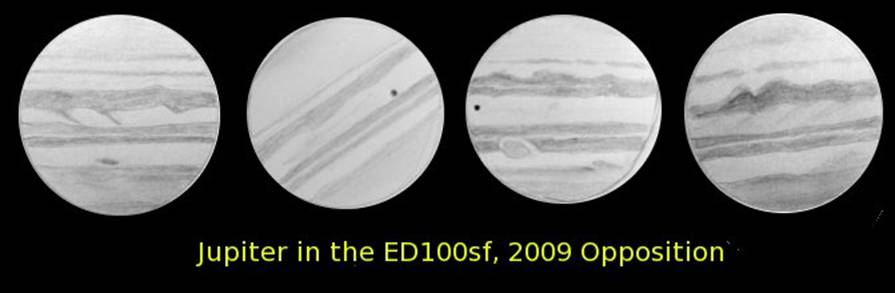
Within the solar system, you have planets, the moon, the sun, and comets. Personally, I get the most joy from planetary observing. You can see rings and bands on Saturn, as well as its larger moons. With favorable conditions, you can observe the polar ice caps on Mars, as well as dark markings on the planet surface. Venus is so bright and low in the sky (therefore subject to atmospheric turbulence), it is usually just a blurry blob. My favorite planet to observe is Jupiter. Its bands and giant storms such as the GRS are prominent features that change over the seasons. Jupiter’s four Galilean moons are always visible (unless they happen to be behind the planet). If you are lucky, you can watch lunar shadows transit along the surface. Here are sketches I made based on observations of Jupiter (the ED100sf is the type of telescope I was using):
The moon is full of craters, volcanoes, rilles (valleys), and mountains. All of them are catalogued, and some are quite challenging to see, requiring perfectly still air to discern. You can spend a lifetime ticking off features on the moon. With a proper filter, you can safely observe the sun. Sunspots can be easily seen and you can follow how they change from day to day:

Every year or so, we are graced by a comet passing through our solar system. Heat from the sun causes the comet to shed ice and dust, forming a tail. The brightest ones make the news feed, and finder maps published by Sky and Telescope, among other organizations, that show where to find the comet on any given day. A comet is a bit of a crap shoot; some are spectacular, others are not.
Stars
Stars appear as a bright disk surrounded by rings in the telescope. This is due to the resolving power of the optics, and the wave property of light. Depending on its size and age, a star will have a certain color. Most stars are not very interesting in my opinion, with a couple of exceptions. Double Stars are stars that may actually be gravitationally bound, or just happen to be on the same line of sight (visual doubles). Double stars can have a disparity in brightness or color, which makes for good viewing. Others are so tight that you can only resolve them under the best conditions. Carbon stars are deeply red compared to other stars; it is fun to see just how different they are.
Deep Sky Objects (DSO)
DSO are some of the grandest showpiece objects. Unfortunately, they are also the most affected by light pollution, because of low surface brightness. It takes skill and patience to find these objects, and tease out the finest details in the eyepiece. DSO comprise of star clusters, nebulae, and galaxies. The brightest DSO can be seen with the naked eye. If you look up and see a bright knot in the night sky, it most likely is a DSO.
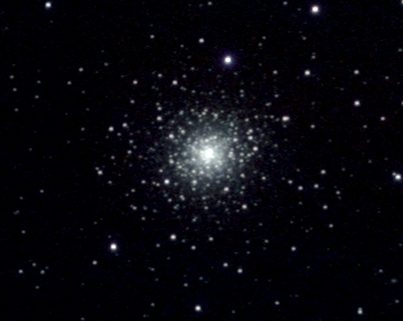
There are two types of star clusters: open and globular. Open clusters are a relatively loose collection of stars. They can be visual, or actually traveling through space together. Some of them look like diamonds on velvet. Globular clusters look like salt poured on a dark table. They are always round in appearance. Here is one that is called M92 (this is a photo; you probably won’t see the colors, nor such brightness):
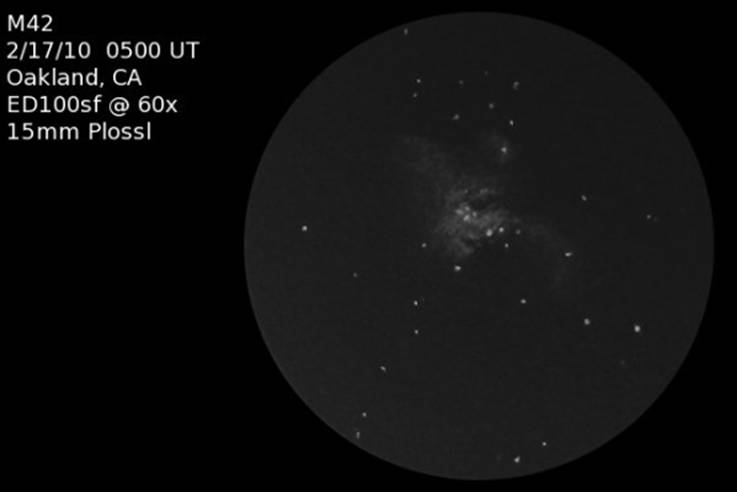
Nebulae (plural of nebula), are glowing clouds of gas and dust. Some are formed by supernovae (exploding stars), dying stars, or dust clouds where new stars are being formed. Understanding the life cycle of stars makes nebulae more interesting. In the wintertime, the constellation Orion showcases M42, the Orion Nebula. It is a stellar nursery complete with bright new stars and glowing clouds of ionized gas. Even in an urban area, you should be able to make out its characteristic bat-like shape. In a large telescope, you can see some of the color shown in photographs. Here is a sketch I made with a 4-inch telescope. The original image is pencil on paper; what you see has been digitally inverted.
To see another galaxy is to see another world. Perhaps someone there is looking back. Most galaxies are quite dim, so they are a challenge. Galaxy hunters usually take advantage of dark skies and large apertures. There are still a handful of galaxies with good brightness, within reach even in the city. The Andromeda galaxy is so close that you can see it with the naked eye. How cool is that?
Light-years
A light-year is the distance that light can travel in one year, about 6 trillion miles. Distances in space are measured in light-years. For example, the aforementioned Orion Nebula is 1,344 light years away. Which means that the light hitting our eyes took 1,344 years to get here, and we are looking back that far in time. The further you look, the farther back in time you see. This is why we build telescopes to look further and further, back into the origins of the universe. A telescope is a time machine.
Conclusion
Astronomy is a great hobby. Obviously, there is a lot to discuss. Allow me to say, don’t start by dumping a lot of money into it. Money doesn’t make you a great observer; observing does. You don’t need a lot of expensive gear to start observing. Also, astrophotography will exponentially increase the cost of this hobby. There are ways to do it cheaply, but work on your observing skills first.
 Misanthrope Hobbies